

Jaw Surgery Specialist for Facial Aesthetics in NYC: The Ultimate Patient Guide
If you have been searching for a jaw surgery specialist who understands both function and facial aesthetics, New York City is one of the best places in the world to find one. Orthognathic surgery — the clinical term for corrective jaw surgery — is a procedure that repositions the upper jaw, lower jaw, or both to restore proper bite alignment and improve the proportions of your face. This guide covers everything a prospective patient needs to know, from candidacy criteria to the technology that makes modern aesthetic jaw surgery so precise.
What Is Orthognathic Surgery and Why Is It Performed?
Orthognathic surgery corrects skeletal discrepancies between the upper and lower jaws that braces alone cannot fix. According to Mount Sinai’s Division of Oral & Maxillofacial Surgery, the procedure involves moving the maxilla and mandible to an anatomically correct position, which allows for a good bite, an open airway, and facial symmetry. Conditions that typically require surgical correction include severe overbites, underbites, crossbites, open bites, facial asymmetry from congenital deformities or trauma, and obstructive sleep apnea caused by jaw position.
While the primary indications are functional, the aesthetic transformation can be equally dramatic. Research published by the European Society of Medicine notes that orthognathic surgery plays a critical role in harmonizing skeletal alignment, enhancing soft-tissue dynamics, and optimizing airway function — ultimately improving both facial aesthetics and quality of life.
How Jaw Surgery Improves Facial Aesthetics: Five Key Changes
Many patients pursue jaw surgery not only to resolve pain or bite dysfunction but also to achieve a more balanced appearance. Here are the specific aesthetic improvements orthognathic surgery can deliver:
- Facial Symmetry — Correcting uneven jawlines or misaligned chins results in a more balanced look from every angle.
- Profile Refinement — Surgery can adjust the angle and alignment of the jaw, improving the contour of both the face and neck.
- Defined Jawline — A well-defined jawline is widely associated with youth and vitality; repositioning the mandible or maxilla can restore or create this definition.
- Harmonized Features — When the jaw sits in its correct position, surrounding features such as the nose, lips, and cheekbones appear more proportional.
- Lower-Face Proportion — Genioplasty (chin surgery), often performed alongside jaw surgery, refines the labio-mental angle and enhances jawline definition, cervico-mental angles, and structural support for the lower face.
Who Is a Candidate for Aesthetic Jaw Surgery?
You may be a good candidate if you have:
- A significant bite misalignment that affects chewing, speaking, or breathing
- Chronic jaw pain, popping, or locking related to TMJ disorders
- Obstructive sleep apnea linked to jaw position
- Visible facial imbalance such as a receding chin, prominent jaw, or asymmetry
- A condition classified as Class II (retrognathic/small lower jaw), Class III (prognathic/prominent lower jaw), vertical maxillary excess (gummy smile), or short lower face
Candidates should generally be at least 18 years old and have completed jaw growth. Good overall health and realistic expectations about outcomes are also important. A combined approach of orthodontics plus surgery has been shown in peer-reviewed research to deliver clear benefits in enhancing facial appearance compared with orthodontic camouflage alone.
The Role of 3-D Virtual Surgical Planning
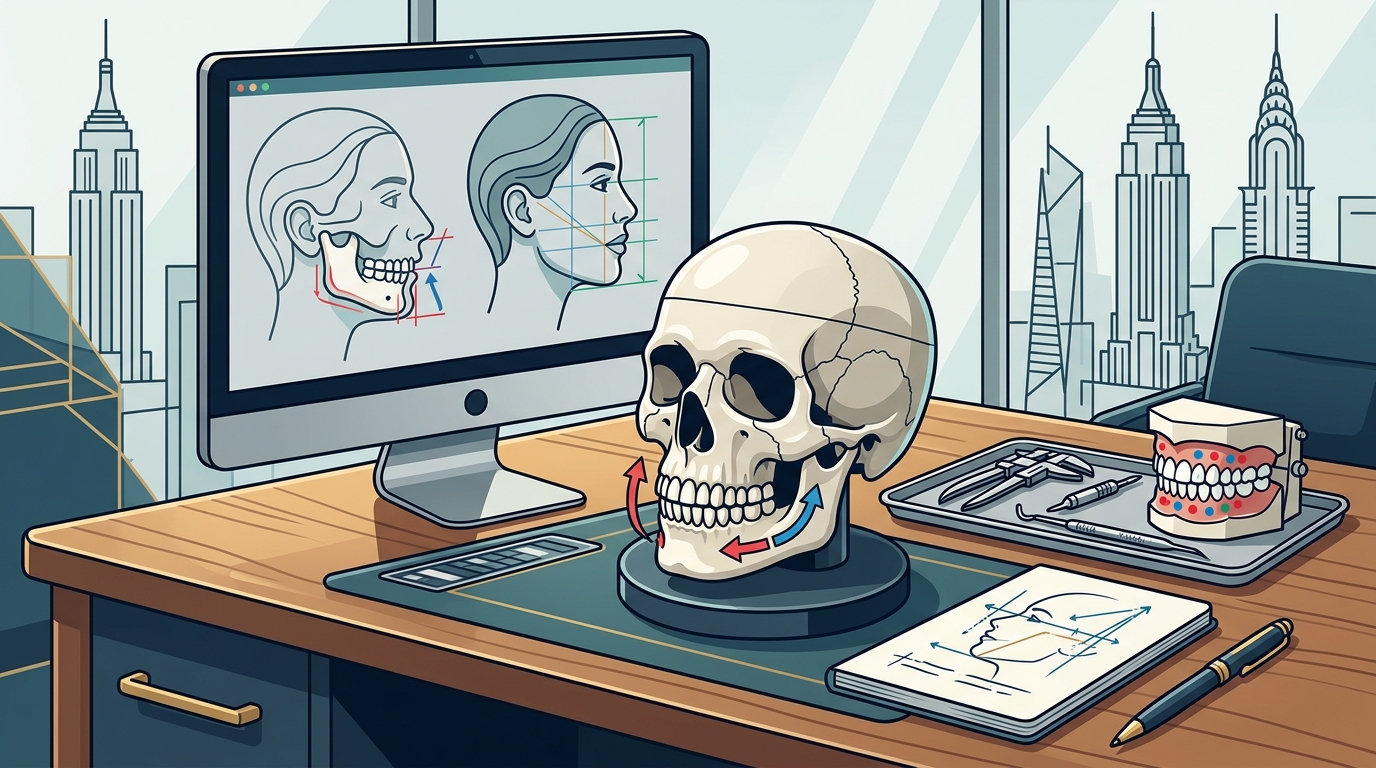
Modern jaw surgery depends heavily on digital technology. Cone-beam CT scans, 3-D photomorphometry, and virtual surgical planning (VSP) allow the surgeon to rehearse the operation in a virtual environment before touching the patient. Mount Sinai describes VSP as an extremely accurate tool that helps predict the procedure’s outcome and enables the design and fabrication of surgical guides using 3-D printers to ensure accurate transfer of the plan to the operating room.
At Park Avenue Oral, Maxillofacial & Implant Surgery on Manhattan’s Upper East Side, Dr. James Choi, MD, DMD, FACS uses virtual surgical planning, CT-guided protocols, and a Medtronic piezoelectric saw — a technology that cuts bone precisely while protecting adjacent soft tissue — as part of his minimally invasive approach.
What to Expect: Timeline and Recovery
| Phase | Duration | What Happens |
|---|---|---|
| Pre-surgical orthodontics | 6 – 18 months | Braces position teeth over the bone for optimal surgical results |
| Surgery day | 1 – 5 hours | Performed under general anesthesia; incisions are made inside the mouth; titanium plates and screws secure the new alignment |
| Hospital stay | 1 – 2 nights | Monitoring and initial pain management |
| Early recovery | 2 – 6 weeks | Liquid and soft-food diet, limited activity, swelling management with cold compresses |
| Post-surgical orthodontics | 6 – 12 months | Final tooth alignment to the new jaw position |
| Full functional recovery | Up to 12 months | Return of normal chewing function; residual bone remodeling |
Jaw Surgery Cost in NYC and Insurance Coverage
Jaw surgery costs in New York City typically range from $6,000 to $20,000 depending on the complexity of the case. Single-jaw procedures are generally less expensive than double-jaw surgery, and adjunct procedures such as genioplasty may increase the total. Most insurance plans cover orthognathic surgery when it is deemed medically necessary for functional problems rather than purely cosmetic reasons. Park Avenue Oral, Maxillofacial & Implant Surgery accepts in-network insurances and can help coordinate documentation for insurance approval.
Why Choose a Board-Certified Oral & Maxillofacial Surgeon in NYC
When the goal is both function and facial aesthetics, credentials matter. Here is what to look for:
- Board certification in Oral & Maxillofacial Surgery — ensures completion of a surgical residency and passage of rigorous specialty examinations.
- Fellowship of the American College of Surgeons (FACS) — an honor given only to surgeons who pass strict ethical and clinical standards, vetted by peers for excellence in their surgical field.
- Dual-degree training (MD + DMD/DDS) — provides a comprehensive understanding of both medical and dental aspects of jaw and facial surgery.
- Advanced fellowship training — look for fellowships in minimally invasive surgery, craniofacial surgery, or facial plastic surgery for aesthetic-focused outcomes.
- Technology investment — practices that use VSP, piezoelectric instrumentation, and CT-guided protocols tend to deliver greater precision and faster recovery.
Dr. James Choi at Park Avenue Oral, Maxillofacial & Implant Surgery checks every box. He is a board-certified oral and maxillofacial surgeon with dual MD and DMD degrees, FACS designation, and unique fellowship training in minimally invasive surgery at the University of Munich, Germany. His practice philosophy centers on four pillars: minimally invasive surgery, minimal pain, faster recovery, and safe and comfortable anesthesia.
Complementary Aesthetic Procedures Often Paired with Jaw Surgery
Because jaw surgery repositions the skeletal foundation of the face, it creates an opportunity to address other aesthetic goals at the same time or during recovery:
- Sliding genioplasty (chin surgery) — repositions the chin bone to achieve ideal lower-face balance; preferred over implants because it offers stable, predictable results with natural soft-tissue draping.
- Jawline enhancement — non-invasive options such as dermal fillers or Botox, or surgical approaches including liposuction and FaceTite, can further define the jawline after skeletal correction.
- Functional septoplasty or rhinoplasty — when combined with maxillary repositioning, these procedures can correct nasal obstructions and optimize breathing efficiency alongside facial aesthetics.
Key Takeaways
- Orthognathic surgery corrects skeletal jaw discrepancies that braces alone cannot fix, delivering both functional and significant aesthetic improvements.
- Modern 3-D virtual surgical planning allows your surgeon to rehearse the operation digitally, producing customized surgical guides for millimeter-level precision.
- Aesthetic changes include improved facial symmetry, a refined profile, a defined jawline, harmonized features, and better lower-face proportion.
- Recovery takes time — expect 6 weeks of dietary restrictions and up to a year for full functional return — but results are long-lasting.
- Insurance typically covers the surgery when it is medically necessary; NYC costs generally range from $6,000 to $20,000.
- Choosing a board-certified, fellowship-trained oral and maxillofacial surgeon with FACS designation and advanced technology is critical to achieving the best aesthetic outcome.
Frequently Asked Questions
Does jaw surgery really change the way your face looks?
Yes. Orthognathic surgery enhances facial balance, jawline definition, chin projection, and overall harmony. Many patients look more confident, youthful, and symmetrical after treatment. The lower third of the face — especially the lower lip and chin — typically shows the most noticeable changes.
How long does recovery take after jaw surgery?
Most patients are off work or school for two weeks to one month. A liquid and soft-food diet is necessary for roughly six weeks. Return to normal chewing may take two months, with full functional recovery taking up to one year.
Is jaw surgery covered by insurance in NYC?
Most insurance plans cover orthognathic surgery when it is deemed medically necessary — for example, to correct a bite problem affecting chewing, speech, or breathing. Purely cosmetic cases may not be covered. Your surgeon’s office can help submit documentation to your insurance carrier.
What is virtual surgical planning and why does it matter?
Virtual surgical planning uses 3-D CT scans and computer modeling to simulate the surgery before it happens. This technology improves accuracy, helps predict outcomes, and enables fabrication of patient-specific surgical guides on 3-D printers — translating the digital plan directly into the operating room.
Can chin surgery be done at the same time as jaw surgery?
Yes. Genioplasty is a common adjunct to orthognathic surgery and can significantly improve lower-face aesthetics when mandibular repositioning alone is insufficient. Sliding genioplasty offers stable, predictable results and is the preferred technique for achieving lower-face harmony.
What qualifications should I look for in a jaw surgery specialist?
Look for board certification in oral and maxillofacial surgery, FACS designation, dual-degree medical and dental training, fellowship experience in minimally invasive or craniofacial surgery, and a practice that uses virtual surgical planning and piezoelectric instrumentation.