

Dental implants have become the gold standard for replacing missing teeth, boasting long-term success rates between 95% and 98%. However, like any surgical procedure, dental implant surgery carries certain risks and potential complications that patients should understand before committing to treatment. Knowing what can go wrong, how likely it is, and what steps minimize those risks empowers you to make a confident, informed decision. This guide covers every major risk category, the data behind complication rates, and how choosing a board-certified oral surgeon on Park Avenue in NYC can make all the difference.
Understanding Dental Implant Risks
Dental implant risk is the possibility that an unwanted outcome occurs during or after the surgical placement of a titanium post into the jawbone. While implant dentistry has advanced dramatically, no procedure is entirely without risk. A 2024 retrospective study in the Journal of Pharmacy and Bioallied Sciences found that roughly two-thirds of patients experienced no complications at all following dental implant surgery.
Complications range from minor, temporary discomfort to more serious issues like implant failure or nerve injury. The good news is that most risks are manageable or preventable when your surgeon follows strict protocols and uses modern technology. At our implant surgery center, every case begins with thorough diagnostic imaging and treatment planning to anticipate and avoid potential problems.
Most Common Complications and Their Rates
A clear picture of complication frequency helps set realistic expectations. The table below summarizes findings from peer-reviewed research on 150 dental implant cases.
| Complication | Incidence Rate | Severity |
|---|---|---|
| Infection | 15.3% | Moderate (treatable with antibiotics) |
| Peri-implantitis | 10 – 20% | Moderate to serious if untreated |
| Implant failure | 2 – 8% | Serious (may require removal) |
| Nerve injury | < 6% | Variable (temporary to lasting) |
| Sinus complications | < 6% | Moderate (upper jaw only) |
| Prosthetic failure | < 6% | Minor (crown or abutment issue) |
| No complications | ~66.7% | N/A |
Peri-implantitis is inflammation and bone loss around an implant, often caused by bacterial buildup. It represents one of the most significant long-term threats to implant longevity. Early detection through routine checkups is critical for successful treatment.
Short-Term Risks After Surgery
In the first one to two weeks after implant placement, patients commonly experience swelling, mild bleeding, and bruising. These are normal healing responses rather than true complications.
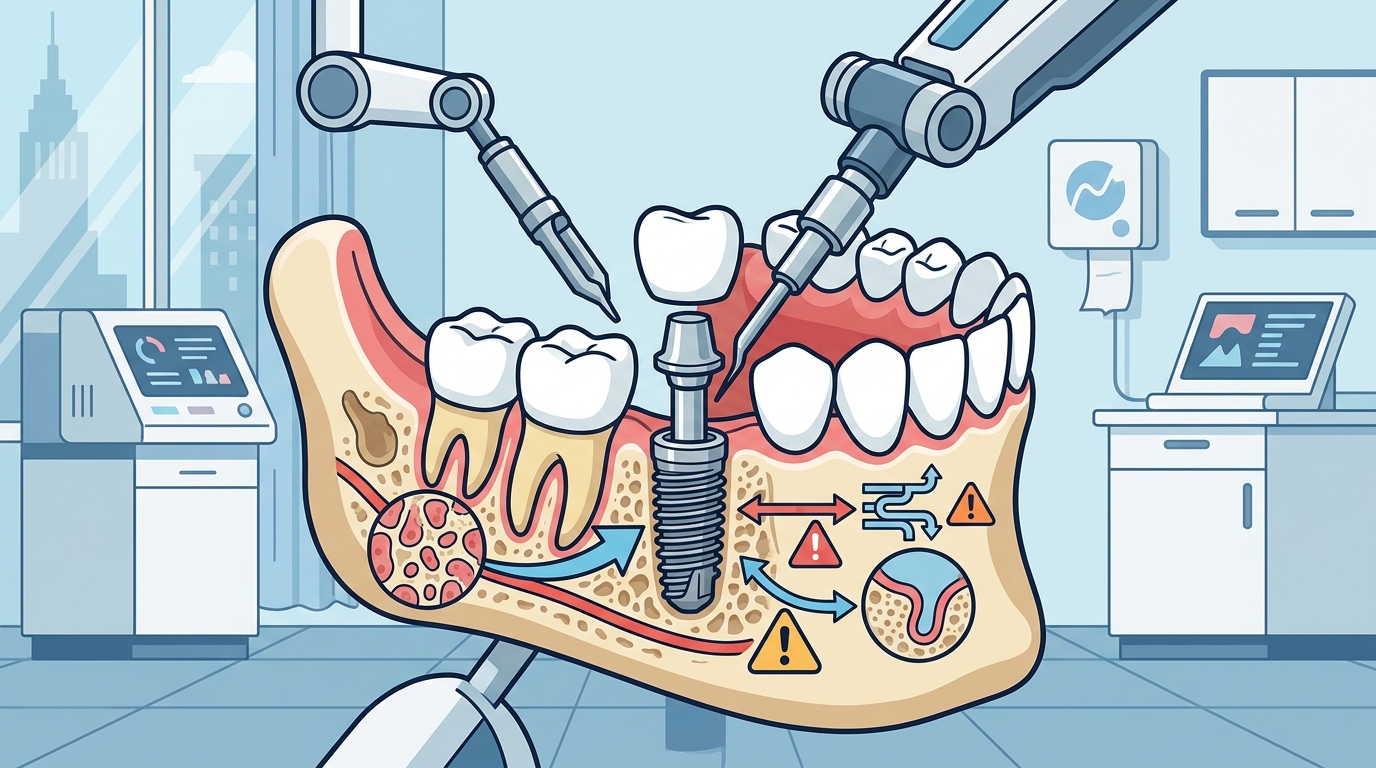
Infection
Post-surgical infection is the most frequently reported complication. It typically presents with swelling, pain, and discharge within the first few days. Strict aseptic technique during surgery and prescribed antibiotics significantly reduce this risk. Our surgeons follow rigorous safe anesthesia and sterility protocols to protect every patient.
Bleeding and Hematoma
Excessive bleeding or hematoma formation is uncommon but can occur, particularly in patients on blood-thinning medications or those who do not follow post-operative instructions. Proper post-op care, including ice application and rest, helps prevent these issues.
Nerve Injury
Nerve damage, particularly to the inferior alveolar nerve in the lower jaw, can cause numbness, tingling, or pain. This risk is greatly reduced through CT-guided implant placement, which maps nerve pathways before surgery with millimeter precision.
Long-Term Risks and How to Prevent Them
Long-term dental implant complications affect fewer than 5% of patients over a 10-year period when implants are properly maintained. The primary long-term concerns include peri-implantitis, gradual bone loss, and mechanical issues with the prosthetic crown.
Peri-implantitis and Bone Loss
Without consistent oral hygiene and professional cleanings every three to six months, bacteria can colonize the implant site and trigger progressive bone loss. Catching peri-implantitis early allows treatment with non-surgical methods like deep cleaning and antibiotics. Advanced cases may require bone grafting procedures to restore lost tissue.
Implant Failure and Osseointegration Problems
Osseointegration is the biological process by which the jawbone fuses directly with the titanium implant surface. Failure of this process can result from excessive surgical trauma, premature loading, or patient health conditions. If an implant does fail, our team specializes in rescuing and replacing failing implants.
Sinus Complications
Upper jaw implants placed near the sinus cavity carry a small risk of sinus membrane perforation. A sinus lift procedure performed before or during implant placement addresses insufficient bone height and reduces this risk considerably.
Patient Risk Factors That Increase Complications
Not every patient faces the same level of risk. Several health and lifestyle factors can increase the likelihood of complications.
- Smoking: Smokers face roughly three times the implant failure rate compared to non-smokers. Tobacco disrupts blood flow and impairs osseointegration.
- Uncontrolled diabetes: Patients with poorly managed blood sugar may experience up to 40% higher complication rates due to impaired wound healing.
- Poor oral hygiene: Inadequate brushing and flossing accelerates bacterial buildup around implants.
- Bone density: Low-density bone (Type III or IV) is associated with higher failure rates. One study found that 75% of failed implants were placed in lower-density bone.
- Autoimmune conditions: Diseases like rheumatoid arthritis can affect healing, though proper management often still allows successful implant treatment.
A thorough medical evaluation during your initial visit helps identify these factors so your treatment plan can be adjusted accordingly.
How Advanced Technology Minimizes Risk
Modern surgical technology has dramatically reduced complication rates compared to earlier decades. At Park Avenue Oral Surgery, several innovations contribute to safer outcomes.
CT-guided surgical planning uses three-dimensional imaging to map bone volume, nerve locations, and sinus boundaries before a single incision is made. Virtual surgical planning further refines implant positioning with digital accuracy.
Piezoelectric instrumentation, available through our Medtronic piezoelectric saw, cuts bone with ultrasonic precision while preserving surrounding soft tissue and nerves. This results in less trauma and faster healing.
Platelet-rich fibrin (PRF) therapy uses the patient's own blood to create a healing concentrate applied directly to the surgical site. Learn more about PRF and accelerated healing on our site.
Key Takeaways
- Dental implants have a 95% to 98% success rate, but understanding possible risks is essential for informed consent.
- Infection (15.3%), peri-implantitis (10 to 20%), and implant failure (2 to 8%) are the most commonly reported complications.
- Approximately two-thirds of implant patients experience no complications whatsoever.
- Smoking, uncontrolled diabetes, and poor oral hygiene are the top modifiable risk factors.
- CT-guided placement and virtual surgical planning significantly reduce the chance of nerve injury and implant misalignment.
- Long-term complications affect fewer than 5% of patients over 10 years with proper maintenance.
- Choosing a board-certified, fellowship-trained oral surgeon is one of the most important decisions you can make to minimize risk.
Frequently Asked Questions
What is the most common complication after dental implant surgery?
Infection is the most frequently reported complication, occurring in approximately 15.3% of cases according to retrospective research. It is typically manageable with antibiotics and proper wound care.
How often do dental implants fail?
The overall failure rate ranges from about 2% to 8%, depending on the study and patient population. Most failures occur within the first few months before the implant fully integrates with the bone.
Does smoking affect dental implant success?
Yes. Smokers are roughly three times more likely to experience implant failure. Quitting smoking before and after surgery is one of the most impactful steps a patient can take.
What is peri-implantitis?
Peri-implantitis is an inflammatory condition affecting the gum and bone tissue surrounding a dental implant. Left untreated, it leads to progressive bone loss and potential implant loss.
Can nerve damage from dental implants be permanent?
Nerve injury, particularly to the inferior alveolar nerve, can cause numbness or tingling. In most cases symptoms are temporary, but precise surgical planning with CT imaging greatly reduces this risk.
Are upper jaw implants riskier than lower jaw implants?
Upper jaw (maxillary) implants can carry additional risk due to proximity to the sinus cavities and often softer bone. Research shows that 83% of failed implants in one study were located in the upper jaw.
How can I reduce my risk of dental implant complications?
Maintain excellent oral hygiene, attend all follow-up appointments, quit smoking, manage chronic conditions like diabetes, and choose an experienced board-certified oral surgeon for your procedure.
Does insurance cover dental implant complications?
Many major PPO insurance plans cover aspects of implant treatment and related complications. Visit our financial information page for details on accepted insurance plans.
Take the Next Step Toward a Safe Implant Experience
Understanding risks is the first step toward a successful outcome. At Park Avenue Oral Maxillofacial and Implant Surgery, our board-certified, dual-degree, fellowship-trained surgeons combine advanced technology with meticulous technique to keep complication rates well below national averages. Book your consultation today and let our team create a personalized treatment plan that prioritizes your safety and comfort.