

Dental implants are artificial tooth roots surgically placed into the jaw to support crowns, bridges, or dentures. With advances in oral surgery, patients now have several implant types to choose from, each designed for different jaw conditions and restoration goals. Understanding these options helps you have a more productive conversation with your surgeon and make a confident decision. At Park Avenue Oral Surgery in New York City, our board-certified, dual-degree surgeons evaluate every patient individually to recommend the ideal implant solution.
Endosteal Implants: The Gold Standard
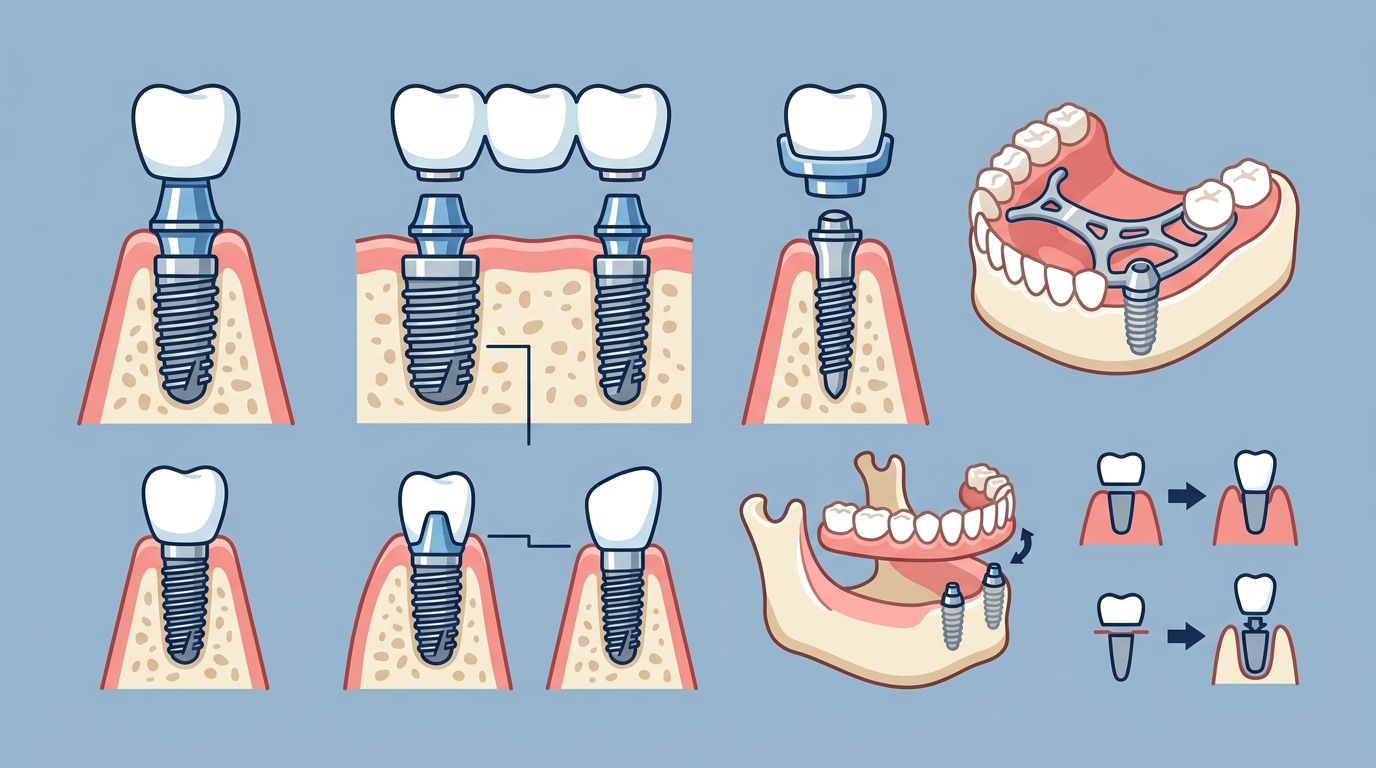
An endosteal implant is a titanium or zirconia post placed directly into the jawbone, where it fuses with surrounding bone through a process called osseointegration. This is the most widely used implant type, accounting for more than 90% of all implant procedures.
How They Work
Each endosteal implant consists of three components: the implant body (artificial root), an abutment (connector), and a crown (visible tooth). After the post is placed, a healing period of three to six months allows the bone to integrate. Once stable, the abutment and final restoration are attached.
Best Candidates
Endosteal implants work best for patients with adequate jawbone width and density. If bone loss has occurred, a bone graft or sinus lift may be recommended before placement. Long-term success rates exceed 95%, making this the benchmark against which all other types are measured.
Subperiosteal Implants: When Bone Is Limited
A subperiosteal implant is a custom metal framework placed beneath the gum tissue but on top of the jawbone. Posts extend through the gums to hold prosthetic teeth. This design was created specifically for patients who lack sufficient bone height for endosteal implants and prefer to avoid bone grafting.
As the gums heal, tissue grows around the framework to anchor it in place. While less common today due to improvements in grafting techniques, subperiosteal implants still serve patients for whom grafting is not medically advisable. They represent roughly 5% of implant procedures.
Zygomatic and Pterygoid Implants
A zygomatic implant is a longer implant anchored into the zygomatic bone (cheekbone) rather than the upper jaw. It is designed for patients with severe bone loss in the maxilla who would otherwise need extensive grafting. Because the cheekbone does not atrophy the way the jaw can, it provides a reliable anchor point.
Park Avenue Oral Surgery offers both zygomatic and pterygoid implant options, performed by fellowship-trained surgeons experienced in these advanced techniques. Pterygoid implants engage the pterygoid plate behind the maxilla, adding another option for patients with compromised upper-jaw bone.
All-on-X Full-Arch Implants
The All-on-X concept uses four or more strategically angled implant posts to support an entire arch of fixed replacement teeth. This approach often eliminates the need for bone grafting by tilting posterior implants to engage available bone.
Patients who have lost most or all teeth in an arch can receive a provisional set of teeth the same day as surgery. Final zirconia or acrylic prostheses are fabricated after healing. All-on-X is one of the fastest-growing solutions in implant dentistry for full-mouth rehabilitation.
Mini Dental Implants
Mini dental implants (MDIs) are narrower-diameter posts, typically 1.8 to 3.0 mm wide. They are often used to stabilize lower dentures or to replace small teeth in areas with limited space. Placement is less invasive and recovery is generally quicker, though MDIs are not suitable for heavy load-bearing restorations.
Side-by-Side Comparison Table
| Implant Type | Placement Site | Best For | Bone Grafting Needed? | Typical Success Rate |
|---|---|---|---|---|
| Endosteal | Jawbone | Most patients with adequate bone | Sometimes | 95%+ |
| Subperiosteal | On top of jawbone, under gum | Patients with low bone height | No | 90%+ |
| Zygomatic | Cheekbone (zygoma) | Severe upper jaw bone loss | No | 95%+ |
| All-on-X | Jawbone (angled posts) | Full-arch tooth loss | Rarely | 94-98% |
| Mini Implants | Jawbone (narrow diameter) | Denture stabilization, small spaces | Rarely | 90-95% |
How to Choose the Right Implant Type
Selecting the right implant depends on several clinical and personal factors. Bone density and volume are evaluated using CBCT imaging, which our practice provides through CT-guided implant planning. The number and location of missing teeth, your overall medical history, and your restoration goals all influence the recommendation.
Why Surgeon Expertise Matters
Advanced implant types like zygomatic and pterygoid placements require specialized surgical training. Board-certified oral and maxillofacial surgeons with fellowship training bring the experience needed for complex cases. At Park Avenue Oral Surgery, our surgeons hold dual MD and DMD degrees, providing a depth of medical and dental knowledge that benefits every patient. Learn more about our team and credentials.
The Role of Technology
Modern tools such as virtual surgical planning, piezoelectric instrumentation, and PRF (platelet-rich fibrin) improve precision and accelerate healing. These technologies help reduce surgical time, minimize discomfort, and increase the predictability of outcomes.
Key Takeaways
- Endosteal implants are the most common type, placed directly into the jawbone with success rates above 95%.
- Subperiosteal implants offer an alternative for patients who lack bone density and cannot undergo grafting.
- Zygomatic and pterygoid implants anchor into the cheekbone or pterygoid plate, bypassing severe upper jaw bone loss.
- All-on-X implants can restore an entire arch of teeth, often in a single surgical visit.
- Mini implants are ideal for denture stabilization and narrow-ridge situations.
- CBCT imaging and virtual surgical planning help your surgeon select and precisely place the best implant type.
- Choosing a board-certified oral surgeon with fellowship training is critical for complex implant cases.
Frequently Asked Questions
What is the most common type of dental implant?
Endosteal implants are by far the most common, making up over 90% of all dental implant procedures. They are placed directly into the jawbone and are suitable for most patients with healthy bone.
Can I get dental implants if I have bone loss?
Yes. Options include bone grafting to rebuild the jaw, or alternative implant types such as subperiosteal, zygomatic, or All-on-X implants that work with reduced bone volume.
What are zygomatic implants?
Zygomatic implants are longer implants anchored into the cheekbone instead of the upper jaw. They are designed for patients with severe maxillary bone loss who want to avoid extensive grafting procedures.
How long do dental implants last?
With proper care and regular dental visits, most dental implants can last 20 years or longer. Many endosteal implants last a lifetime when maintained correctly.
Are mini implants as strong as regular implants?
Mini implants are effective for stabilizing dentures and replacing smaller teeth, but they are not designed for heavy load-bearing restorations. Your surgeon will advise whether they are appropriate for your situation.
What is the All-on-X procedure?
All-on-X is a full-arch restoration technique that uses four or more implant posts to support a complete set of fixed teeth. It is often completed in a single day and may eliminate the need for bone grafting.
Does insurance cover dental implants?
Many major PPO insurance plans provide partial coverage for dental implants. Park Avenue Oral Surgery is in-network with several insurers. Visit our financial information page for details.
How do I know which implant type is right for me?
A consultation with a board-certified oral surgeon, including a clinical exam and CBCT scan, is the best way to determine the ideal implant type for your anatomy and goals.
Schedule Your Dental Implant Consultation in NYC
Ready to explore which dental implant type is right for you? Our fellowship-trained, board-certified oral surgeons at Park Avenue Oral Surgery on Park Avenue in Manhattan provide personalized treatment plans using the latest technology. Book your consultation today and take the first step toward a confident, lasting smile.