

If you are missing one or more teeth, dental implants offer the most reliable, long-lasting solution available in modern dentistry. But not all implants are the same. Understanding the different types of dental implants helps you make an informed decision and work more effectively with your oral surgeon. At Park Avenue Oral Surgery in New York City, our board-certified, dual-degreed surgeons offer every major implant type to match each patient's unique anatomy and goals. This guide breaks down each option so you know exactly what to expect.
What Are Dental Implants?
A dental implant is a titanium or zirconia post surgically placed into the jaw to serve as an artificial tooth root. Once the implant fuses with the surrounding bone through a process called osseointegration, it provides a permanent foundation for crowns, bridges, or dentures. According to the American Dental Association, implants are the closest replacement to natural teeth because they integrate directly with the bone, preventing bone loss and preserving facial structure.
Osseointegration is the biological process by which living bone bonds directly to the surface of a titanium implant. This mechanism is the reason dental implants boast success rates above 95% over 10 years.
Endosteal Implants: The Gold Standard
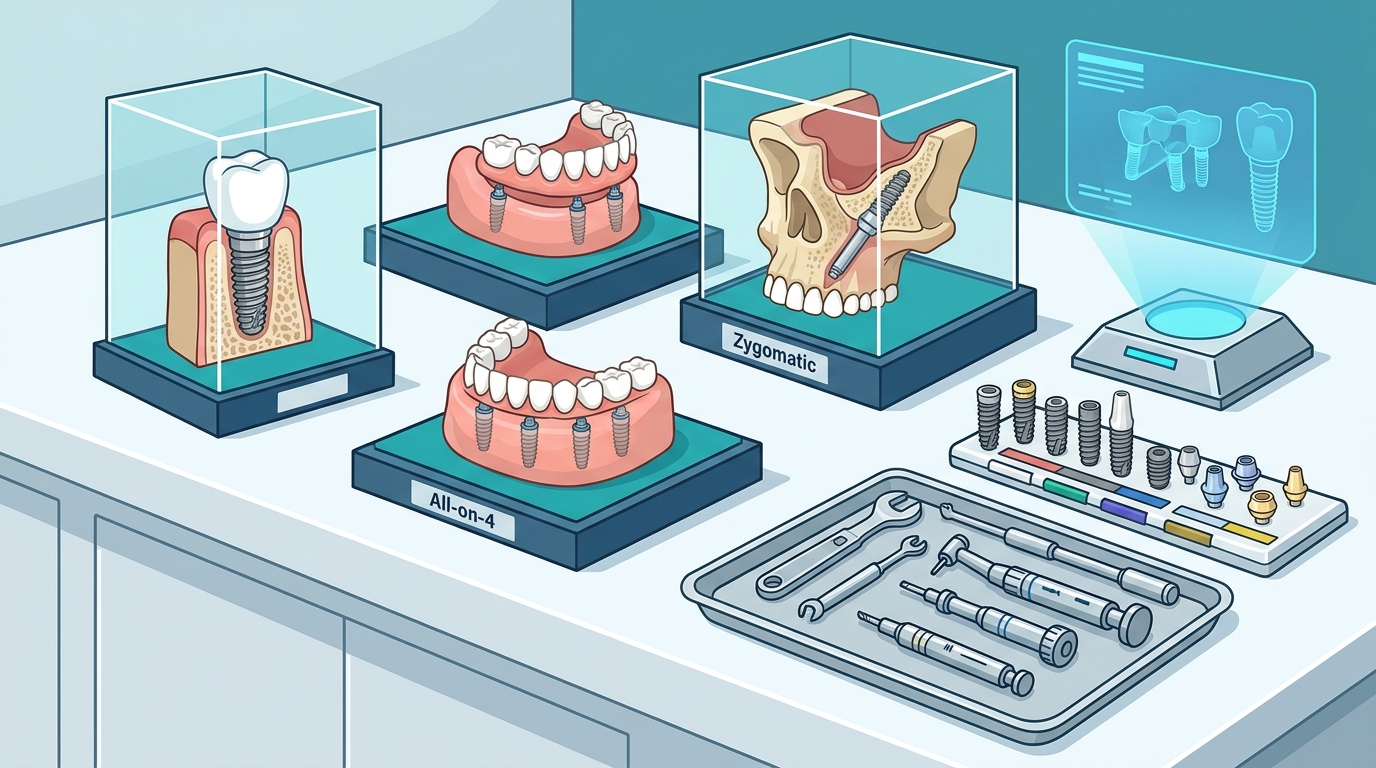
An endosteal implant is a screw-shaped titanium post placed directly into the jawbone. It is the most common type of dental implant, accounting for more than 90% of all implant procedures performed worldwide. The basic components include the implant body (artificial root), an abutment (connector piece), and a prosthetic crown.
Who Is a Good Candidate?
Endosteal implants work best for patients who have healthy jawbone with sufficient width and density. If bone volume is insufficient, a bone grafting procedure may be recommended before implant placement. Patients who currently wear dentures or bridges are often excellent candidates.
Success Rates and Benefits
Endosteal implants have the highest long-term success rate of any implant type, exceeding 95%. They look and feel like natural teeth, restore full chewing function, and help prevent jawbone deterioration. At our Park Avenue practice, we use CT-guided implant placement technology for sub-millimeter precision.
Subperiosteal Implants: An Alternative for Low Bone Density
A subperiosteal implant is a custom metal framework placed on top of the jawbone but beneath the gum tissue. Posts attached to the framework protrude through the gum to hold prosthetic teeth. Unlike endosteal implants, subperiosteal implants do not require drilling into the bone.
When Are They Used?
Subperiosteal implants are designed for patients who lack sufficient bone density for traditional implants and cannot or choose not to undergo bone grafting. While less common today due to advances in grafting techniques, they represent roughly 5% of implant procedures and remain a viable option for select patients.
Limitations
Because the framework sits on the bone rather than within it, subperiosteal implants do not provide the same biting strength or longevity as endosteal implants. They also carry a somewhat higher risk of loosening over time. Your surgeon will carefully evaluate whether this approach suits your anatomy during your initial consultation.
Zygomatic Implants: For Severe Upper Jaw Bone Loss
A zygomatic implant is a longer titanium post anchored into the zygomatic bone (cheekbone) rather than the upper jawbone. This approach bypasses the maxilla entirely, making it ideal for patients with severe upper jaw atrophy. Our surgeons are specially trained in zygomatic and pterygoid implant placement, a complex procedure that not all oral surgery practices offer.
Key Advantages
Zygomatic implants often eliminate the need for bone grafting or sinus lift surgery, reducing overall treatment time. Because the cheekbone does not atrophy, there is always sufficient bone available for anchorage. For patients facing severe bone loss, zygomatic implants can be a life-changing solution when other options fail.
All-on-X (Full Arch) Implants
All-on-X is a full arch restoration technique that uses four or more strategically placed implant posts to support an entire arch of fixed replacement teeth. This approach is popular among patients who are missing most or all teeth in one jaw. Learn more about our All-on-X implant program on Park Avenue.
How It Works
Two implants are placed vertically in the front of the jaw, and two are placed at an angle in the back to maximize contact with available bone. A fixed prosthetic arch is then attached, often on the same day as surgery. This technique frequently avoids bone grafting, shortens treatment timelines, and restores full function rapidly.
Dental Implant Types Comparison Table
| Feature | Endosteal | Subperiosteal | Zygomatic | All-on-X |
|---|---|---|---|---|
| Placement Location | Into jawbone | On top of jawbone | Into cheekbone | Into jawbone (angled) |
| Bone Density Required | Sufficient | Low/insufficient | Severe loss OK | Moderate to low |
| Bone Graft Needed? | Sometimes | No | Rarely | Rarely |
| Success Rate | 95%+ | ~90% | ~95% | ~95% |
| Typical Healing Time | 3-6 months | 3-6 months | 3-6+ months | Same-day to 6 months |
| Best For | Single or multiple teeth | Patients avoiding grafts | Severe upper jaw loss | Full arch replacement |
| Relative Cost | $$ | $$-$$$ | $$$-$$$$ | $$$ |
How to Choose the Right Implant Type
Choosing the right dental implant depends on several factors: jawbone density, the number of missing teeth, overall health, and your treatment goals. Advanced imaging tools such as 3D CT scans allow your surgeon to evaluate bone structure precisely before recommending a treatment plan.
Conditions like diabetes, osteoporosis, or tobacco use may affect healing and influence which implant type is appropriate. At Park Avenue Oral Surgery, we use virtual surgical planning to simulate every procedure digitally before the first incision, maximizing safety and predictability.
Financial considerations also matter. Endosteal implants are typically the most cost-effective, while zygomatic implants carry higher fees but can eliminate expensive grafting procedures. Visit our financial information page for details on accepted PPO insurances and payment options.
Key Takeaways
- The four main types of dental implants are endosteal, subperiosteal, zygomatic, and All-on-X (full arch).
- Endosteal implants are the most common, accounting for over 90% of procedures, with success rates above 95%.
- Subperiosteal implants serve patients who lack adequate bone and prefer to avoid grafting surgery.
- Zygomatic implants anchor into the cheekbone, offering a solution for severe upper jaw bone loss without grafting.
- All-on-X provides a full arch of fixed teeth using as few as four implant posts, often with same-day results.
- Advanced imaging and virtual surgical planning improve precision and outcomes for every implant type.
- A consultation with a board-certified oral surgeon is the essential first step toward the right choice.
Frequently Asked Questions
What is the most common type of dental implant?
Endosteal implants are by far the most common, making up over 90% of all dental implant procedures. They are placed directly into the jawbone and offer the highest long-term success rates.
Can I get dental implants if I have bone loss?
Yes. Subperiosteal and zygomatic implants are specifically designed for patients with insufficient jawbone. Bone grafting or a sinus lift can also rebuild bone to support endosteal implants.
How long do dental implants last?
With proper care, dental implants can last 20 years or longer. Many patients enjoy their implants for a lifetime. Regular dental check-ups and good oral hygiene are critical for long-term success.
Are zygomatic implants safe?
Yes. Zygomatic implants are an FDA-approved, well-studied solution for patients with significant upper jawbone loss. However, the procedure is complex and should only be performed by a specially trained oral and maxillofacial surgeon.
What is the recovery time for dental implants?
Recovery varies by type. Endosteal and subperiosteal implants typically require 3 to 6 months for osseointegration. Zygomatic implants may take longer depending on case complexity. All-on-X patients often receive temporary teeth the same day.
How much do dental implants cost in NYC?
Costs vary depending on the implant type, number of implants, and whether additional procedures like bone grafting are needed. Endosteal implants are generally the most affordable option. Contact our office for a personalized estimate and to learn about accepted insurance plans.
What is All-on-4 vs. All-on-X?
All-on-4 is a branded version of the All-on-X concept, using exactly four implants per arch. All-on-X is the broader term that includes four, five, or six implants depending on what the patient's anatomy requires.
Do dental implants hurt?
Modern implant surgery is performed under local anesthesia or IV sedation, and most patients report minimal discomfort. At Park Avenue Oral Surgery, we also offer EXPAREL long-acting local anesthesia for extended post-operative comfort.
Ready to Restore Your Smile?
Whether you need a single-tooth replacement or a full arch restoration, the board-certified surgeons at Park Avenue Oral Surgery in New York City are here to help. We combine fellowship-trained expertise with advanced technology to deliver predictable, comfortable results. Book your consultation today and take the first step toward a healthier, more confident smile.