
How to Choose the Best Oral Surgeon in NYC: 7 Essential Criteria
Finding the right oral surgeon in New York City can feel overwhelming. With hundreds of practitioners marketing similar services, knowing which criteria actually matter is the key to a safe, successful outcome. Whether you need wisdom teeth removal, dental implants, or corrective jaw surgery, your choice of surgeon directly shapes your results. This guide walks you through seven evidence-based criteria so you can make a confident, informed decision and protect your health every step of the way.
1. Verify Board Certification
Board certification is the single most important credential to look for in an oral surgeon. It is a voluntary achievement that goes beyond basic licensure, requiring the surgeon to pass rigorous written and oral examinations administered by the American Board of Oral and Maxillofacial Surgery (ABOMS). Unlike a standard license, board certification confirms an outstanding record of clinical success and a commitment to lifelong learning.
ABOMS diplomates must also complete yearly Certification Maintenance, which includes peer evaluation, knowledge testing, and office anesthesia evaluations. This ongoing process means a board-certified surgeon stays current with the latest techniques and safety protocols throughout their entire career.
2. Evaluate Education and Training Depth
Not all training paths are equal. An oral and maxillofacial surgeon (OMS) is a specialist who completes dental school followed by four to six years of hospital-based surgical residency. Some surgeons go further by earning a dual degree, holding both a Doctor of Medicine (M.D.) and a Doctor of Dental Medicine (D.M.D.), which provides a uniquely comprehensive medical and surgical foundation.
Why Fellowship Training Matters
Fellowship training is an additional period of subspecialty education beyond residency. Surgeons who complete fellowships gain focused expertise in areas like minimally invasive surgery, facial cosmetic procedures, or craniofacial reconstruction. For example, Dr. James Choi, MD, DMD, FACS at Park Avenue Oral Surgery completed a fellowship in minimally invasive surgery at the University of Munich, Germany, adding international-caliber training to his credentials.

3. Look for Advanced Technology and Techniques
Modern oral surgery relies on precision tools that improve outcomes and shorten recovery. When evaluating a practice, ask about the specific technologies they use.
| Technology | What It Does | Patient Benefit |
|---|---|---|
| Virtual Surgical Planning (VSP) | Creates 3D digital models and custom surgical guides before surgery | Shorter operative time, improved accuracy |
| CT-Guided Implant Placement | Uses 3D scans to map ideal implant positioning | Predictable results, reduced complications |
| Piezoelectric Surgery | Uses ultrasonic vibrations to cut bone while preserving soft tissue | Less bleeding, faster healing |
| Exparel (Extended Pain Relief) | Long-acting, non-opioid local anesthetic lasting up to 3 days | Reduced need for opioid medications |
| PRP/PRF Therapy | Concentrates your own growth factors to enhance healing | Faster bone regeneration, fewer complications |
A practice that invests in cutting-edge surgical technology signals a commitment to better patient outcomes and minimally invasive care.
4. Assess Anesthesia Safety Credentials
Anesthesia safety is a critical and often overlooked factor. Your surgeon's office should be fully licensed and inspected by the State of New York to administer sedation and general anesthesia. The surgeon should hold current certifications in Advanced Cardiovascular Life Support (ACLS), Pediatric Advanced Life Support (PALS), and Basic Life Support (BLS).
A dual-degree oral surgeon with an M.D. has undergone extensive hospital-based anesthesia rotations alongside anesthesiologists, giving them the medical training to manage complex sedation scenarios. Learn more about what to expect from safe and comfortable anesthesia options, including local anesthesia, nitrous oxide, IV sedation, and general anesthesia.
5. Check Hospital Affiliations
Hospital privileges are a strong quality indicator. When a surgeon holds attending privileges at major hospitals, it means the institution has independently verified their credentials, malpractice history, and clinical competency. In NYC, affiliations with top-ranked hospital systems add an extra layer of trust.
What FACS Designation Means
FACS stands for Fellow of the American College of Surgeons. It is a distinction awarded only to surgeons who demonstrate an outstanding record in complex cases and pass rigorous ethical and clinical peer review. Only a small percentage of oral and maxillofacial surgeons in New York City hold this designation.
6. Consider the Patient Experience
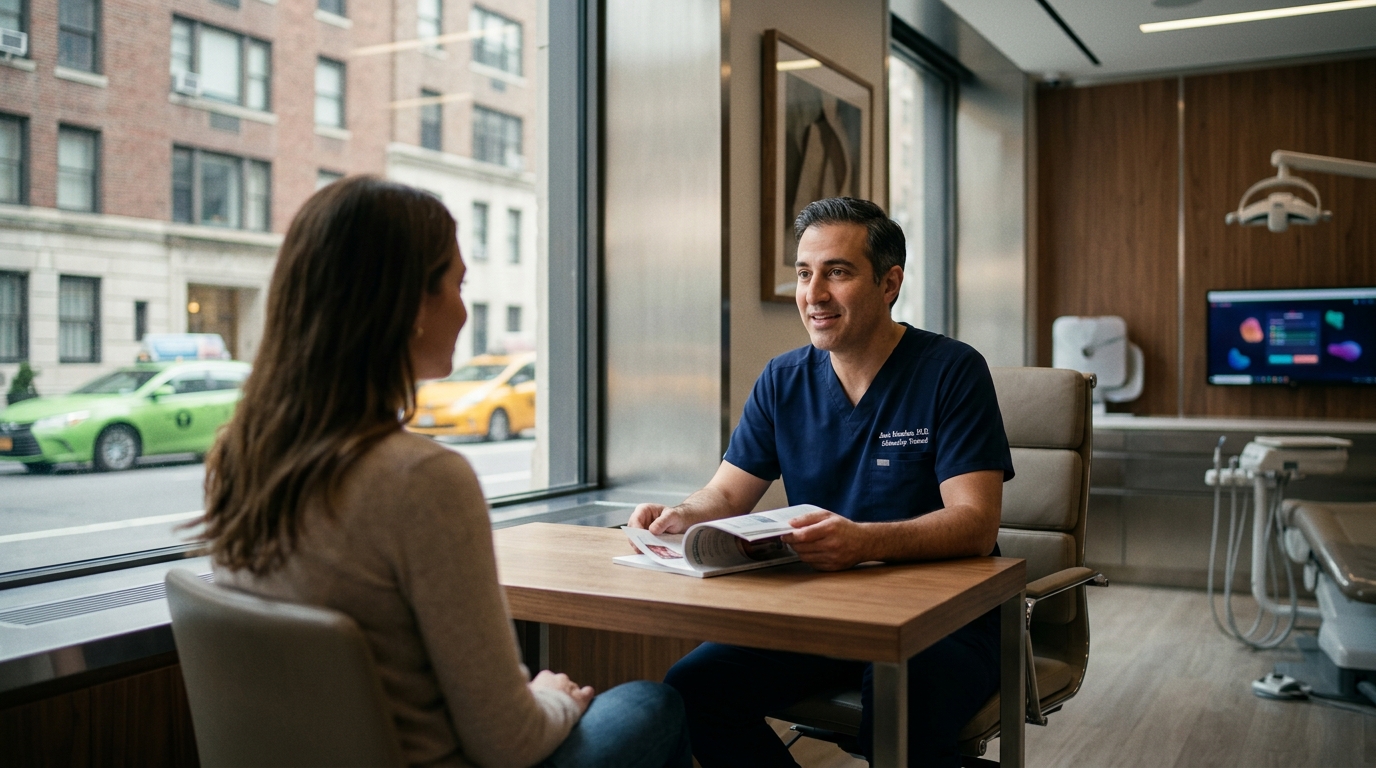
Clinical credentials matter, but so does your comfort. During a consultation, pay attention to how the surgeon communicates. Do they explain your diagnosis clearly? Do they present realistic expectations? A good surgeon will walk you through imaging, discuss alternatives, and answer every question without rushing you.
Look for practices that prioritize personalized care, from streamlined patient registration and visit preparation to after-hours access for post-surgical emergencies. The best practices treat the entire experience, not just the procedure.
7. Confirm Insurance and Financial Transparency
Oral surgery costs in NYC can vary widely. Before committing, verify that the practice is in-network with your specific PPO plan. Even within the same insurance carrier, different employer-negotiated plans carry different benefits and coverage levels.
A transparent practice will help you understand your out-of-pocket costs upfront and offer guidance on maximizing your insurance benefits. Practices that accept major PPO insurances like MetLife, Guardian, and Cigna give you greater flexibility and savings.
Key Takeaways
- Board certification by ABOMS is the highest credential in oral and maxillofacial surgery and should be your first filter.
- Dual-degree surgeons (M.D. and D.M.D.) have both medical and dental training, enabling safer anesthesia management and more comprehensive care.
- Fellowship training signals subspecialty expertise in areas like minimally invasive surgery or craniofacial reconstruction.
- Advanced technology such as VSP, CT-guided implant placement, and piezoelectric surgery leads to shorter procedures and faster recovery.
- Hospital affiliations and FACS designation provide independent verification of a surgeon's competency.
- Patient experience, including communication style, after-hours access, and personalized treatment plans, is a legitimate quality indicator.
- Always verify in-network insurance status and request a clear cost breakdown before scheduling surgery.
Frequently Asked Questions
What is a board-certified oral surgeon?
A board-certified oral surgeon is a specialist who has passed comprehensive written and oral examinations through the American Board of Oral and Maxillofacial Surgery (ABOMS) and commits to ongoing certification maintenance. This credential goes beyond basic licensure to verify clinical expertise and ethical standards.
How do I verify if my oral surgeon is board certified?
You can ask the surgeon directly during your consultation or search the ABOMS online directory by name or location. A reputable surgeon will be transparent about their credentials.
What is the difference between an oral surgeon and a dentist?
A general dentist provides preventive and restorative dental care. An oral and maxillofacial surgeon is a specialist who completes an additional four to six years of hospital-based surgical residency training, including rotations in anesthesia, emergency medicine, and general surgery. They handle complex procedures involving the mouth, face, and jaw.
Why does dual-degree (M.D. and D.M.D.) training matter?
A dual-degree surgeon has completed both medical school and dental school. This combined training provides a deeper understanding of whole-body health, anesthesia pharmacology, and complex medical conditions, making them uniquely qualified for advanced surgical and sedation procedures.
Is minimally invasive oral surgery better?
Minimally invasive techniques use smaller incisions, ultrasonic instruments, and advanced imaging to reduce tissue trauma. This typically translates to less swelling, less pain, lower complication rates, and faster recovery times compared to traditional approaches.
Does insurance cover oral surgery in NYC?
Most major PPO dental and medical insurance plans cover medically necessary oral surgery procedures such as wisdom teeth extraction, dental implants related to trauma, and corrective jaw surgery. Coverage varies by plan, so it is important to verify your specific benefits before scheduling.
What should I ask during an oral surgery consultation?
Key questions include: Are you board certified by ABOMS? What is your training background? How many of these procedures have you performed? What anesthesia options do you offer? What technology do you use for surgical planning? What are the expected costs after insurance?
How do I find the best oral surgeon near me in New York City?
Start with referrals from your general dentist, then verify board certification, hospital affiliations, and training depth. Look for a surgeon who uses advanced technology, offers multiple anesthesia options, and accepts your insurance. Reading patient reviews and viewing before-and-after cases can also help.
Ready to Choose Your Oral Surgeon?
Selecting the right oral surgeon is one of the most important healthcare decisions you will make. If you are looking for a board-certified, dual-degree, fellowship-trained oral and maxillofacial surgeon on Park Avenue in New York City, we invite you to schedule a consultation with Dr. James Choi, MD, DMD, FACS. Discover the Park Avenue Difference and take the first step toward safe, comfortable, and expert care.