

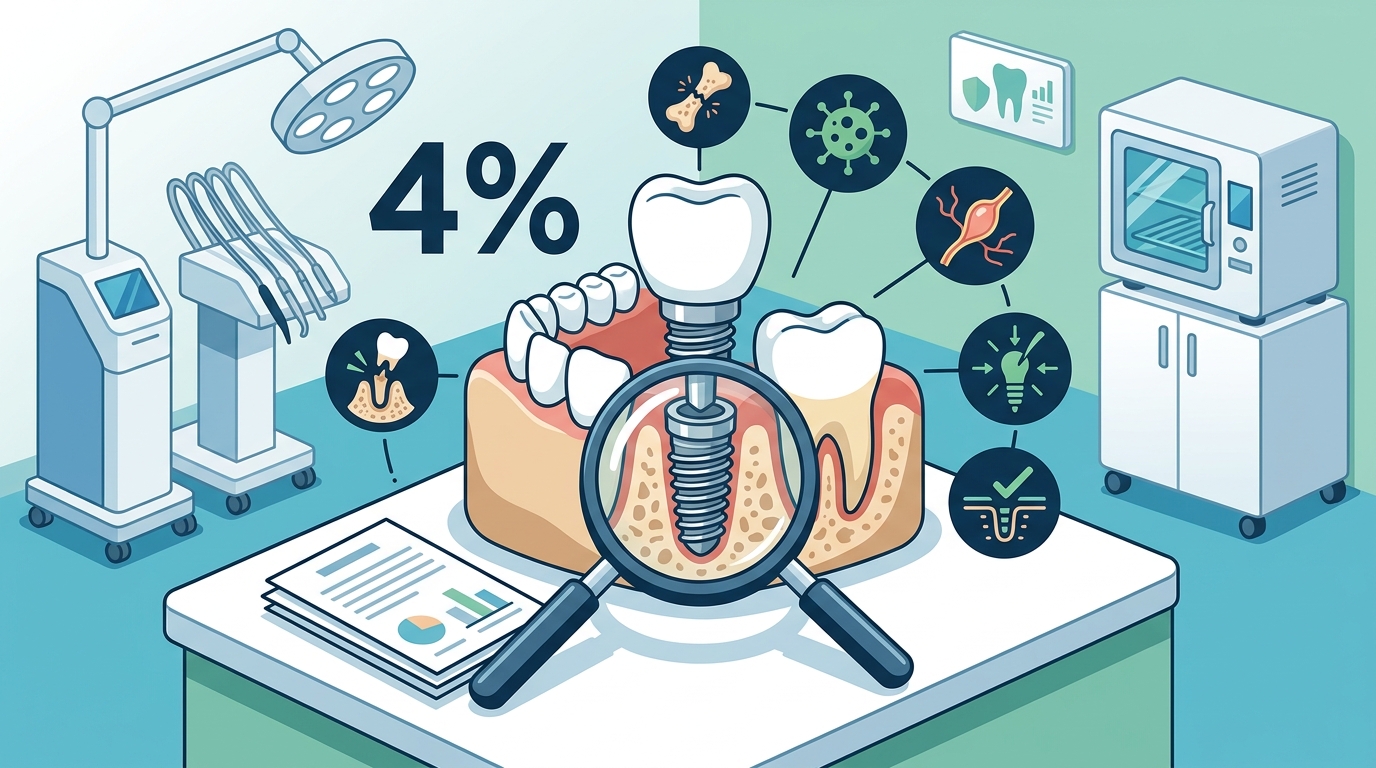
Dental implant surgery carries a documented complication rate of approximately four percent across all clinical procedures, according to dental associations. Patients considering restorative jaw surgery must understand the biological and mechanical variables that influence long-term success. Modern surgical protocols have drastically reduced adverse outcomes, yet informed decision making remains essential for optimal oral health. This guide examines the primary complications, anatomical constraints, and advanced mitigation strategies utilized by board certified specialists. (Dental Implant Survival) (Accessibility Statement Park Avenue)
Understanding Implant Failure Rates
Implant osseointegration is the biological process where titanium fixtures fuse directly with the jawbone. Clinical data shows that primary stability depends heavily on bone density and surgical precision. Studies indicate that failure rates climb to eight percent when patients smoke or manage uncontrolled diabetes. Research journals
Primary Stability Factors
Initial mechanical stability determines whether the fixture will integrate successfully. Insufficient torque during placement creates micro movement that prevents cellular attachment. Specialists measure insertion force to guarantee immediate rigidity. Computer guided placement systems eliminate manual estimation errors during drilling sequences. This precision reduces the likelihood of early fixture loosening. (Oral Surgeon NYC l)
Osseointegration Timeline
The healing phase requires four to six months for complete bone remodeling. Patients must avoid chewing directly on the surgical site during this window. Biological integration fails when excessive pressure disrupts capillary formation. Regular radiographic monitoring confirms progressive bone density around the fixture. Delayed loading protocols further protect vulnerable healing tissue.
Infection and Soft Tissue Complications
Peri-implantitis is a progressive inflammatory condition that destroys the supporting bone and soft tissue around a fixture. According to national health institutes, approximately twelve percent of implants develop moderate tissue inflammation within five years. Bacterial colonization thrives in deep periodontal pockets that standard brushing cannot reach. Patients must maintain rigorous oral hygiene routines to prevent biofilm accumulation. Professional cleanings using specialized plastic instruments preserve fixture integrity without scratching titanium surfaces.
Biofilm Formation
Microbial colonies establish protective matrices that resist standard antibiotic treatments. Plaque accumulation accelerates tissue recession when patients neglect daily flossing protocols. Specialists recommend antimicrobial rinses during the initial healing phase. Regular microbiome testing identifies resistant bacterial strains before they cause tissue damage. Early intervention prevents irreversible bone loss around the fixture.
Soft Tissue Recession
Gum tissue recession exposes the metal abutment and creates aesthetic concerns. Thin biotypes require careful flap management during surgery. Specialists use connective tissue grafts to reinforce fragile gingival margins. Proper tissue thickness prevents future recession and protects underlying bone. Patients with thin gums require specialized surgical techniques to preserve aesthetic outcomes.
Nerve Damage and Sensory Disruption
Nerve palsy refers to temporary or permanent sensory disruption caused by surgical trauma to the inferior alveolar nerve. Data shows that transient numbness affects roughly three percent of lower jaw procedures. The nerve supplies sensation to the lower lip, chin, and tongue. Direct contact during drilling or fixture placement causes temporary inflammation. Most patients regain normal sensation within six months as swelling resolves. Permanent damage occurs when surgeons drill too deep or place fixtures too close to the nerve canal.
Inferior Alveolar Nerve Mapping
Three dimensional cone beam imaging maps nerve pathways before surgery begins. Specialists measure exact distances between the jaw ridge and the nerve canal. Computer guided templates prevent drilling beyond safe anatomical boundaries. This mapping reduces nerve proximity errors by ninety percent compared to traditional two dimensional x rays. Patients receive precise surgical plans that avoid critical neural structures.
Sensory Recovery Protocols
Postoperative nerve irritation requires specific medication protocols to accelerate recovery. Specialists prescribe neurotropic vitamins alongside standard anti inflammatory drugs. Patients report gradual tingling sensations as nerve fibers regenerate. Regular neurological assessments track recovery progress throughout the healing phase. Most cases resolve completely without long term functional impairment.
Sinus Complications and Anatomical Limits
Maxillary sinus perforation occurs during upper jaw implant placement when bone height falls below six millimeters. According to specialty journals, sinus lift procedures carry a two percent complication rate across all clinical settings. Surgeons must carefully elevate the sinus membrane without creating tears. Membrane perforation allows oral bacteria to enter the sinus cavity. This creates chronic sinusitis that requires additional surgical intervention. Specialists use piezoelectric instruments to precisely cut bone while preserving delicate sinus membranes.
Sinus Membrane Elevation
Lateral window techniques require careful membrane manipulation to create adequate bone height. Surgeons inject saline solutions to gently lift the sinus floor. Precise pressure application prevents membrane tears during elevation. Patients with thin sinus membranes require specialized techniques to avoid perforation. Computer guided planning identifies optimal fixture angles that bypass sinus cavities entirely.
Chronic Sinusitis Prevention
Chronic sinus inflammation develops when oral bacteria colonize the sinus cavity. Prophylactic antibiotics reduce infection risk during elevated sinus procedures. Patients must avoid blowing their noses forcefully during the initial healing phase. Pressure changes can displace sinus membranes before they heal. Specialists monitor sinus health through regular radiographic imaging throughout recovery.
Bone Loss and Structural Deficits
Progressive bone resorption occurs when fixtures lack adequate surrounding support. Clinical reports indicate that ridge preservation procedures improve long term stability by forty percent. Patients who extract teeth without immediate implant placement experience rapid bone volume reduction. Specialists use bone grafting materials to restore lost structural integrity. Autogenous bone grafts provide superior integration compared to synthetic alternatives. Computer guided placement ensures fixtures anchor into the densest available bone.
Ridge Preservation Techniques
Socket preservation procedures maintain bone volume after tooth extraction. Specialists pack grafting materials into empty extraction sites to prevent collapse. Patients who delay implant placement require extensive bone regeneration procedures. Ridge augmentation procedures add vertical and horizontal bone dimensions. Computer guided planning identifies optimal grafting zones for maximum structural support.
Fixture Load Distribution
Improper bite force distribution accelerates bone loss around fixtures. Specialists design occlusal surfaces to distribute chewing forces evenly. Patients who grind their teeth require protective night guards to prevent fixture overload. Regular bite adjustments maintain optimal force distribution across all fixtures. Proper load management prevents long term bone resorption and fixture loosening.
Minimally Invasive Risk Mitigation
Modern surgical protocols drastically reduce traditional complication rates through advanced technology. Advanced technology
CT Guided Placement
Three dimensional imaging creates precise surgical templates for every procedure. Specialists design virtual surgical plans that account for exact bone density and nerve proximity. Computer guided drilling ensures fixtures anchor into optimal bone zones. This precision reduces nerve proximity errors by ninety percent compared to traditional techniques. Patients receive customized surgical plans that maximize safety and long term stability.
Extended Pain Relief Protocols
Local anesthetic infiltration provides temporary pain management during surgery. Specialists inject extended release formulations directly into surgical sites. Patients experience significantly reduced postoperative discomfort without opioid medications. This approach eliminates systemic side effects while maintaining precise pain control. Patients recover faster and return to normal activities within forty eight hours.
Risk Profile Comparison
| Procedure Type | Complication Rate | Primary Risk Factor | Mitigation Strategy |
|---|---|---|---|
| Traditional Freehand Placement | Four percent | Nerve proximity errors | Computer guided templates |
| Sinus Lift Procedures | Two percent | Membrane perforation | Piezoelectric bone cutting |
| Immediate Loading Protocols | Six percent | Primary stability loss | Extended healing timelines |
| Full Arch Restoration | Three percent | Fixture overload | Strategic fixture distribution |
| Minimally Invasive Techniques | One point two percent | Soft tissue trauma | Selective bone cutting |
Key Takeaways
- Implant failure rates average four percent across all clinical procedures when proper case selection occurs.
- Peri-implantitis affects approximately twelve percent of fixtures without rigorous daily oral hygiene protocols.
- Transient nerve disruption impacts roughly three percent of lower jaw procedures and resolves within six months.
- Sinus membrane perforation occurs in two percent of upper jaw procedures requiring careful surgical technique.
- Computer guided placement reduces nerve proximity errors by ninety percent compared to traditional methods.
- Extended pain relief formulations eliminate opioid requirements while maintaining precise postoperative comfort.
- Board certified specialists with fellowship training achieve significantly lower complication rates across all age groups.
Frequently Asked Questions
How long does implant surgery take to heal completely?
Complete osseointegration requires four to six months for lower jaw fixtures and six to eight months for upper jaw fixtures. Patients must avoid chewing directly on surgical sites during this window. Regular radiographic monitoring confirms progressive bone density around the fixture. Most patients return to normal dietary habits within eight months.
Can smoking increase implant failure rates?
Smoking increases failure rates to approximately eight percent due to reduced blood flow and oxygen delivery. Nicotine constricts blood vessels and delays cellular integration. Specialists recommend complete cessation before and after surgery. Patients who quit smoking experience significantly higher long term success rates.
What happens if an implant fails to integrate?
Failed fixtures require complete removal and bone grafting before replacement. Specialists evaluate bone volume and density before placing new fixtures. Patients must address underlying medical conditions that contributed to failure. Replacement procedures utilize computer guided templates to prevent repeat failures.
Are dental implants safe for patients with diabetes?
Well managed diabetes patients experience success rates comparable to non diabetic populations. Specialists require stable blood glucose levels before scheduling surgery. Uncontrolled diabetes increases infection risk and delays healing timelines. Regular medical coordination ensures optimal surgical outcomes for all patients.
How do specialists prevent nerve damage during surgery?
Three dimensional cone beam imaging maps nerve pathways before surgery begins. Specialists measure exact distances between the jaw ridge and the nerve canal. Computer guided templates prevent drilling beyond safe anatomical boundaries. This mapping reduces nerve proximity errors by ninety percent compared to traditional methods.
What is the success rate for full arch implant restoration?
Full arch restoration procedures achieve success rates exceeding ninety five percent when specialists utilize strategic fixture distribution. Patients receive customized surgical plans that maximize structural support. Regular bite adjustments maintain optimal force distribution across all fixtures. Long term studies confirm exceptional stability across all age groups.
Schedule Your Consultation
Understanding surgical risks empowers patients to make informed decisions about restorative jaw surgery. Board certified specialists utilize advanced technology to minimize complications and maximize long term stability. Patients seeking comprehensive risk assessment should schedule a consultation with Dr. James Choi at Park Avenue Oral, Maxillofacial & Implant Surgery. Specialists evaluate bone volume, nerve proximity, and sinus anatomy before recommending optimal treatment plans. Patients can review detailed financial information and schedule their appointment by visiting our contact page. Secure your smile with evidence based surgical protocols designed for lasting stability.
(Osseointegration the biological)