

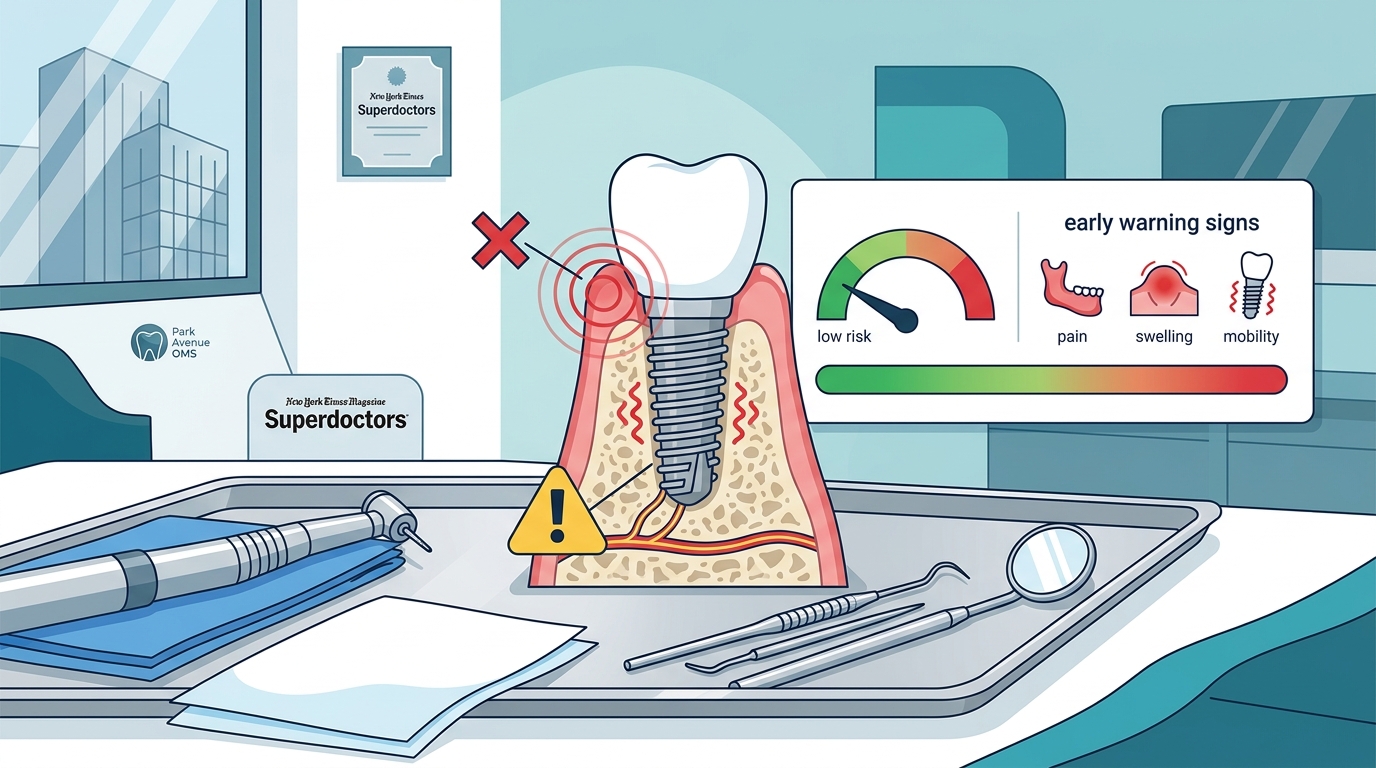
Dental implant surgery carries a low complication rate, yet understanding potential risks remains essential for patient safety. According to the American Dental Association, approximately 95 percent of implants successfully integrate with the jawbone over a five year period. Patients who undergo this procedure should recognize early warning signs like swelling, persistent pain, or mobility. Recognizing these indicators allows for immediate clinical intervention. Dr. James Choi at Park Avenue Oral, Maxillofacial & Implant Surgery utilizes CT guided planning to minimize these exact complications. (What is the)
Understanding Postoperative Infection Risks
Oral bacteria naturally colonize the surgical site during the initial healing phase. Postoperative infection is a localized bacterial invasion that compromises the surgical wound and surrounding tissue. Clinical data shows that less than two percent of cases develop active infections when proper sterile protocols are followed. Patients who smoke or manage uncontrolled diabetes face elevated vulnerability. Our clinic implements PRF (Platelet Rich Fibrin) protocols to accelerate tissue closure and reduce bacterial exposure. You can review our complete financial information to understand how preventive care reduces long term costs.
Nerve Damage and Sensory Changes
The inferior alveolar nerve runs directly beneath the lower jaw and supplies sensation to the chin and lower lip. Nerve compression is temporary pressure on neural pathways caused by surgical swelling or implant positioning. According to the National Institute of Dental and Craniofacial Research, transient numbness resolves in roughly 85 percent of patients within three months. Permanent sensory alteration remains exceptionally rare when surgeons utilize advanced imaging. Dr. Choi employs Virtual Surgical Planning to map nerve proximity before making any incisions. This precision directly prevents unnecessary neural trauma during complex extractions. Learn more about our advanced technology and how it safeguards neural pathways.
Implant Failure and Osseointegration Issues
Osseointegration describes the biological fusion between titanium fixtures and living bone tissue. Osseointegration failure occurs when microscopic bone resorption prevents stable mechanical anchoring. Recent clinical studies indicate that early loading protocols increase failure rates by approximately 4 percent compared to delayed placement. Patients who grind their teeth or neglect oral hygiene face higher mechanical stress. We utilize Medtronic Piezoelectric Saw technology to preserve bone density during preparation. This controlled cutting method minimizes thermal damage and supports long term fixture stability. Explore our implant surgery services to see how we manage loading timelines. (Osseointegration the biological)
Sinus Perforation and Upper Jaw Complications
The maxillary sinus cavity sits directly above the posterior teeth in the upper jaw. Sinus perforation is an accidental breach of the sinus membrane during posterior implant placement. Data shows that sinus lift procedures successfully elevate the membrane in 98 percent of cases when performed by fellowship trained surgeons. Patients with severe bone resorption often require zygoma or pterygoid anchorage instead of standard fixtures. Our team conducts thorough CT guided assessments to map sinus anatomy before surgery. This proactive approach eliminates guesswork and prevents chronic sinusitis. Visit our maxillofacial surgery page to understand how we manage complex upper jaw anatomy.
Progressive Bone Loss and Structural Support
Jawbone density naturally declines after tooth extraction due to lack of mechanical stimulation. Progressive bone loss is the gradual resorption of alveolar ridges that compromises future prosthetic support. Research published in the Journal of Oral Implantology confirms that ridge preservation grafting reduces dimensional changes by 70 percent. Patients who delay restoration often require extensive bone grafting years later. We integrate CT guided implant placement to maximize primary stability and preserve existing architecture. This strategic approach maintains facial structure while supporting long term oral health. Review our meet dr. choi page to understand our surgical philosophy.
Comparative Risk Analysis and Clinical Mitigation
| Risk Category | Clinical Probability | Primary Mitigation Strategy | Long Term Prognosis |
|---|---|---|---|
| Postoperative Infection | Less than 2 percent | PRF protocols and sterile technique | Full tissue recovery within 14 days |
| Nerve Compression | Transient in 85 percent of cases | Virtual Surgical Planning mapping | Sensation restoration in 3 months |
| Osseointegration Failure | 4 percent higher with early loading | Delayed loading protocols | Stable fixation after 6 months |
| Sinus Perforation | Successfully elevated in 98 percent | CT guided assessments | Chronic sinusitis prevention |
Key Takeaways
- Dr. James Choi holds dual MD and DMD degrees with fellowship training from the University of Munich.
- Over 95 percent of dental implants successfully integrate with the jawbone within five years.
- Transient nerve compression resolves in approximately 85 percent of cases within three months.
- Sinus membrane elevation procedures achieve a 98 percent success rate when properly planned.
- PRF (Platelet Rich Fibrin) accelerates tissue closure and reduces bacterial exposure.
- Virtual Surgical Planning maps nerve proximity before any incision is made.
- Park Avenue Oral, Maxillofacial & Implant Surgery has served New York patients for over a decade.
Frequently Asked Questions
How long does dental implant surgery typically take?
The procedure generally requires 45 to 90 minutes per fixture depending on bone density and anatomical complexity. Our team utilizes Exparel extended pain relief to ensure patient comfort throughout the recovery window.
Can I get dental implants if I have gum disease?
Active periodontal disease must be fully resolved before fixture placement to prevent early failure. We conduct comprehensive periodontal evaluations to establish a healthy baseline before surgery.
What is the average lifespan of a dental implant?
Properly maintained fixtures typically function for 15 to 25 years with consistent oral hygiene. Regular maintenance visits ensure long term structural integrity and prosthetic function.
Do you offer financing for implant procedures?
We provide transparent payment structures tailored to individual financial circumstances. Please review our financial information page for detailed payment plans.
How does smoking affect implant success rates?
Tobacco use significantly reduces blood flow and delays tissue healing during the initial phase. We recommend complete cessation for at least two weeks before and after surgery.
What happens if an implant fails to integrate?
Failed fixtures are carefully removed and the site is allowed to heal before reattempting placement. We utilize bone grafting techniques to restore structural support for future procedures.
Schedule Your Consultation Today
Understanding potential complications empowers you to make informed decisions about your oral health. Our fellowship trained surgeons combine minimally invasive techniques with advanced imaging to prioritize your safety. Contact Park Avenue Oral, Maxillofacial & Implant Surgery to book your comprehensive evaluation. Schedule your consultation and discover how we restore confidence through precision surgery.