
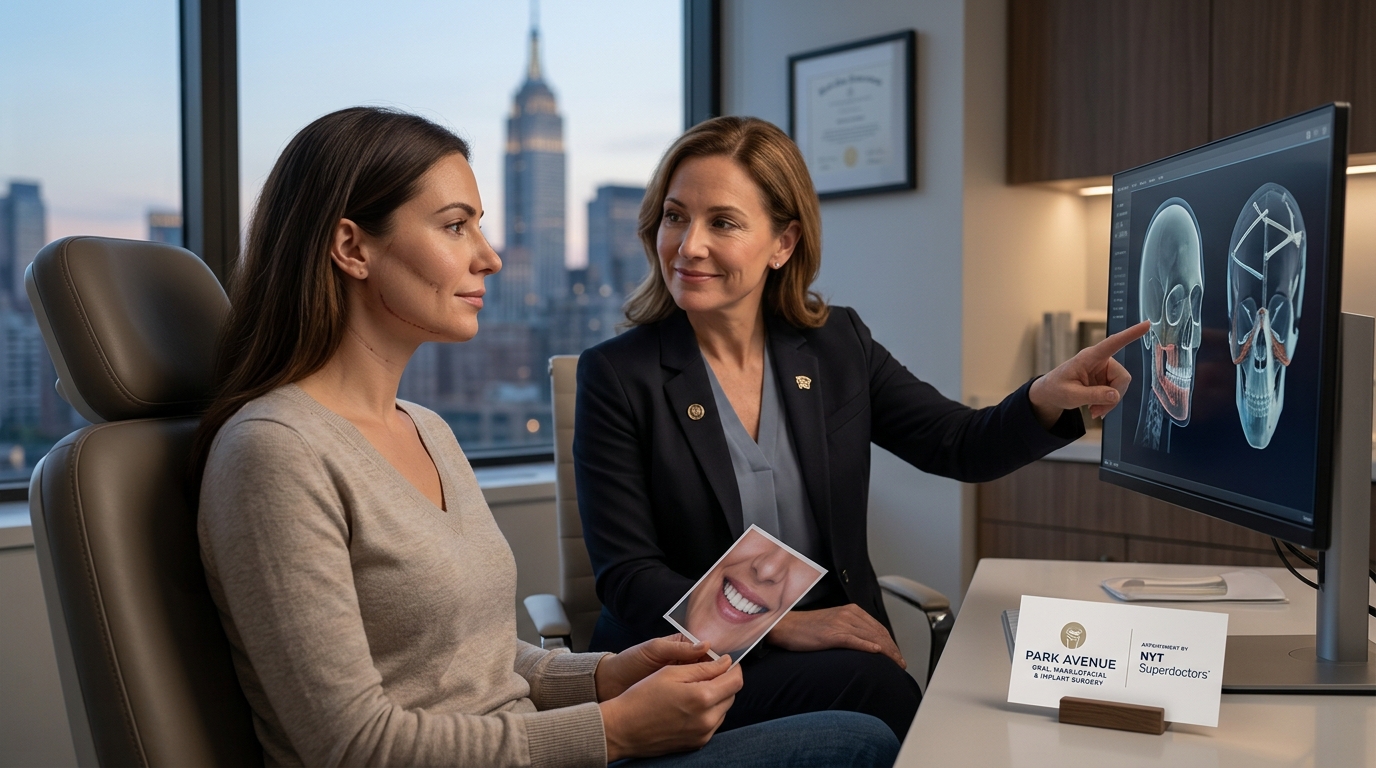
Facial trauma accounts for approximately twenty percent of all emergency department visits involving craniofacial injuries, with mandibular fractures representing the most common skeletal disruption. According to the American Association of Oral and Maxillofacial Surgeons, modern reconstruction techniques now prioritize anatomical precision alongside rapid functional recovery. Patients require immediate evaluation to determine the optimal stabilization method. This guide outlines the clinical pathways available for restoring structural integrity and aesthetic symmetry after severe facial impact. (Accessibility Statement Park Avenue)
Understanding Mandibular Trauma Patterns
Maxillofacial surgery is the specialized medical discipline focused on diagnosing and treating diseases, injuries, and defects of the hard and soft tissues of the face, jaws, and oral cavity. Trauma to the mandible typically occurs during high-impact collisions, falls, or direct blunt force. The fracture lines often follow paths of least resistance through the condylar neck, angle, or symphysis regions. Clinicians evaluate occlusion, nerve integrity, and airway patency before selecting a reconstruction pathway. Early intervention prevents malunion and chronic temporomandibular joint dysfunction. (Oral Surgeon NYC l)
Surgical Stabilization and Fixation Methods
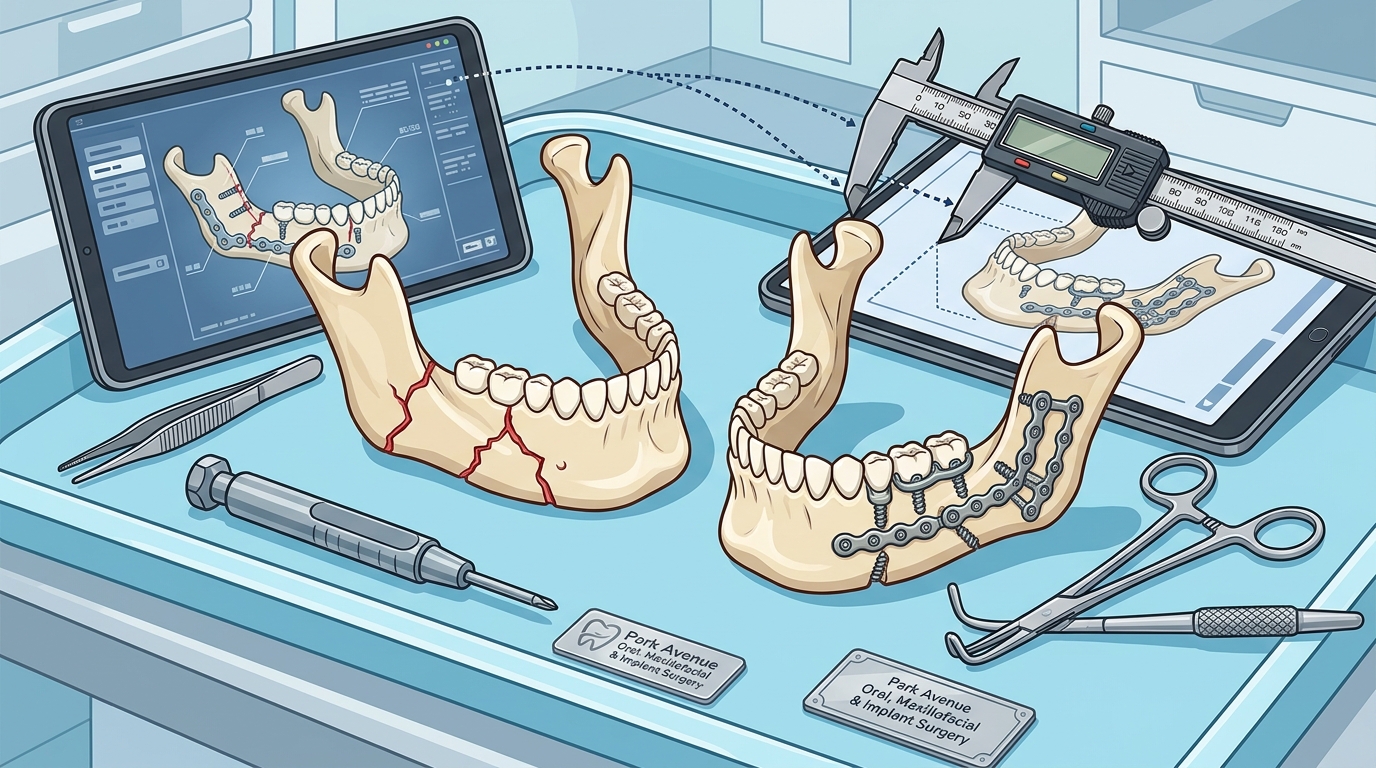
Open reduction internal fixation is the standard surgical approach that involves realigning fractured bone segments and securing them with titanium plates and screws. This technique provides rigid stability, allowing early mobilization of the jaw and reducing the risk of nonunion. Surgeons place miniplates along the inferior border and symphysis to distribute mechanical stress evenly. Closed reduction remains an alternative for select nondisplaced fractures, utilizing maxillomandibular fixation wires to guide healing. The choice depends on fracture complexity, patient age, and functional requirements. (Oral Surgeon NYC l)
Hardware Selection and Biocompatibility
Titanium alloy implants offer superior corrosion resistance and osseointegration compared to older stainless steel alternatives. Modern low-profile plates minimize soft tissue irritation and reduce the likelihood of hardware exposure. Surgeons evaluate bone density to determine screw length and plate thickness. Customized contouring ensures precise anatomical restoration without compromising blood supply to the fracture site. (MEET DR CHOI Park)
Minimally Invasive Reconstruction Techniques
Minimally invasive facial cosmetic procedures and surgical approaches prioritize tissue preservation while maximizing clinical outcomes. Fellowship-trained specialists utilize piezoelectric surgical instruments to cut bone with microscopic precision. These devices vibrate at specific frequencies that selectively cut mineralized tissue while sparing adjacent nerves and blood vessels. The reduced thermal damage translates to significantly less postoperative swelling and faster tissue healing. Patients benefit from smaller incisions and targeted access to complex fracture zones. (IMPLANT SURGERY Park Avenue)
Extended Pain Relief Protocols
Long-acting local anesthetic formulations provide continuous analgesia for seventy-two hours following complex reconstruction. This pharmacological strategy eliminates the need for high-dose opioid prescriptions during the critical first week. Clinicians inject the anesthetic directly into the surgical field before closing incisions. The sustained numbing effect allows patients to maintain basic oral hygiene and gentle jaw movement without severe discomfort.
Advanced Imaging and Virtual Planning
Computer-aided surgical planning utilizes three-dimensional volumetric data to simulate fracture reduction and hardware placement. Radiologists capture high-resolution computed tomography scans to map bone fragments in three spatial dimensions. Digital models allow surgeons to practice osteotomies and plate bending before entering the operating room. This predictive workflow reduces intraoperative time and minimizes the risk of malocclusion. Virtual surgical planning has become the standard of care for complex mandibular reconstructions.
Guided Implant and Fracture Navigation
CT guided implant placement protocols adapt seamlessly to trauma reconstruction by creating patient-specific surgical guides. These transparent templates fit over existing teeth or bone surfaces to direct drill trajectories with submillimeter accuracy. The navigation system compensates for tissue swelling and blood obscuration during live surgery. Surgeons achieve predictable hardware positioning without relying solely on tactile feedback. This technology drastically reduces revision rates and improves long-term occlusal stability.
Postoperative Recovery and Pain Management
Postoperative recovery protocols emphasize structured nutrition, controlled inflammation, and gradual range-of-motion exercises. Patients follow a strict liquid and soft-food diet for the first fourteen days to protect surgical sites. Clinicians prescribe targeted anti-inflammatory medications to manage edema without suppressing necessary bone remodeling. Physical therapy begins within the first week to prevent joint stiffness and muscle atrophy. Compliance with follow-up imaging ensures proper callus formation and hardware integration.
Monitoring Complications and Infection
Early detection of surgical site infections prevents hardware failure and chronic pain syndromes. Clinicians monitor white blood cell counts and local tissue temperature during the first postoperative week. Prophylactic antibiotics are administered intravenously during surgery to establish therapeutic tissue concentrations. Patients receive detailed wound care instructions to maintain oral hygiene without disrupting sutures. Regular clinical evaluations track occlusal alignment and nerve sensation recovery.
Restoring Function and Aesthetic Symmetry
Facial contouring procedures address residual asymmetry caused by bone loss or soft tissue scarring. Subcutaneous fat grafting restores volume to depressed fracture zones and improves skin adherence. Bone grafting techniques utilize autogenous cancellous chips to fill critical segmental defects. These regenerative approaches stimulate native osteogenesis and prevent long-term structural collapse. The combined surgical strategy restores both masticatory efficiency and facial harmony.
| Reconstruction Method | Primary Indication | Recovery Timeline | Technology Utilized |
|---|---|---|---|
| Open Reduction Internal Fixation | Displaced or comminuted fractures | 6 to 8 weeks | Titanium miniplates and screws |
| Maxillomandibular Fixation | Nondisplaced or stable fractures | 4 to 6 weeks | Arch bars and elastics |
| Piezoelectric Bone Resection | Nerve-sparing contouring | 3 to 5 weeks | Medtronic Piezoelectric Saw |
| Virtual Surgical Planning | Complex multi-fragment fractures | 2 to 4 weeks | CT guided Implant Placement |
| Extended Pain Relief Injection | Postoperative analgesia | 72 hours | Exparel Extended Pain Relief |
Key Takeaways
- Mandibular fractures represent the most frequent craniofacial skeletal injury in emergency settings.
- Titanium miniplates provide rigid fixation that enables early functional jaw movement.
- Piezoelectric instruments selectively cut mineralized tissue while preserving adjacent nerves.
- Virtual surgical planning reduces intraoperative time and improves occlusal accuracy.
- Long-acting local anesthetics eliminate opioid dependence during the initial recovery phase.
- CT guided navigation templates ensure submillimeter hardware placement accuracy.
- Board certified specialists with fellowship training deliver evidence-based reconstruction protocols.
Frequently Asked Questions
How long does jaw fracture healing typically take?
Bone consolidation generally requires six to eight weeks for standard fractures and up to twelve weeks for complex segmental injuries. Radiographic confirmation of callus formation precedes the removal of fixation hardware. Patients must adhere to dietary restrictions to prevent hardware stress fractures during the remodeling phase.
Can facial symmetry be fully restored after severe trauma?
Comprehensive reconstruction protocols combine rigid fixation with targeted soft tissue augmentation to reestablish anatomical balance. Subcutaneous fat grafting and precise plate contouring address residual depressions and asymmetry. Long-term follow-up imaging confirms stable occlusal relationships and aesthetic harmony.
What technology minimizes nerve damage during reconstruction?
Piezoelectric surgical systems utilize ultrasonic frequencies to cut bone while sparing adjacent soft tissue structures. These devices prevent thermal necrosis and mechanical transection of the inferior alveolar nerve. The selective cutting action preserves sensation and accelerates mucosal healing.
Is virtual surgical planning covered by insurance providers?
Most major health carriers recognize computer-aided planning as a medically necessary component of complex trauma management. Preauthorization requires detailed radiographic documentation and surgical necessity justification. Clinicians submit comprehensive treatment plans to verify coverage eligibility before scheduling procedures.
How is postoperative pain managed without opioids?
Extended-release local anesthetic formulations provide continuous nerve blockade for seventy-two hours following incision closure. This pharmacological strategy eliminates breakthrough pain spikes and reduces systemic medication requirements. Patients maintain functional mobility while experiencing minimal discomfort during the critical healing window.
What are the risks of hardware exposure after fixation?
Hardware exposure occurs when thin mucosal tissue fails to cover plate edges, typically due to poor blood supply or excessive tension. Low-profile titanium plates minimize soft tissue irritation and reduce exposure probability. Surgeons evaluate tissue thickness during planning to prevent late-stage complications.
When can patients resume normal chewing activities?
Functional chewing typically resumes after eight to twelve weeks once radiographic consolidation is confirmed. Gradual progression from soft foods to regular textures prevents sudden stress on healing bone. Physical therapy exercises restore full range of motion and masticatory efficiency.
Schedule Your Consultation
Recovering from severe facial trauma requires precise surgical planning, advanced technology, and experienced oversight. Board certified specialists with fellowship training deliver evidence-based reconstruction protocols tailored to your anatomical needs. Contact Park Avenue Oral, Maxillofacial & Implant Surgery to evaluate your injury and discuss your personalized restoration pathway. Book your consultation today and begin your path toward complete functional and aesthetic recovery.