

Dental implant technology has evolved significantly over the last decade, offering patients a wide array of restorative options tailored to their specific bone density, budget, and aesthetic goals. According to recent industry data, the global dental implants market is projected to reach a valuation of over $2.5 billion by 2026, reflecting a surge in patient demand for permanent tooth replacement solutions. This growth is driven by advancements in materials science and minimally invasive surgical techniques that reduce recovery times and improve long-term success rates. Understanding the distinct categories of implants is the first step toward reclaiming your oral health and confidence. (Accessibility Statement Park Avenue)
Conventional Dental Implants
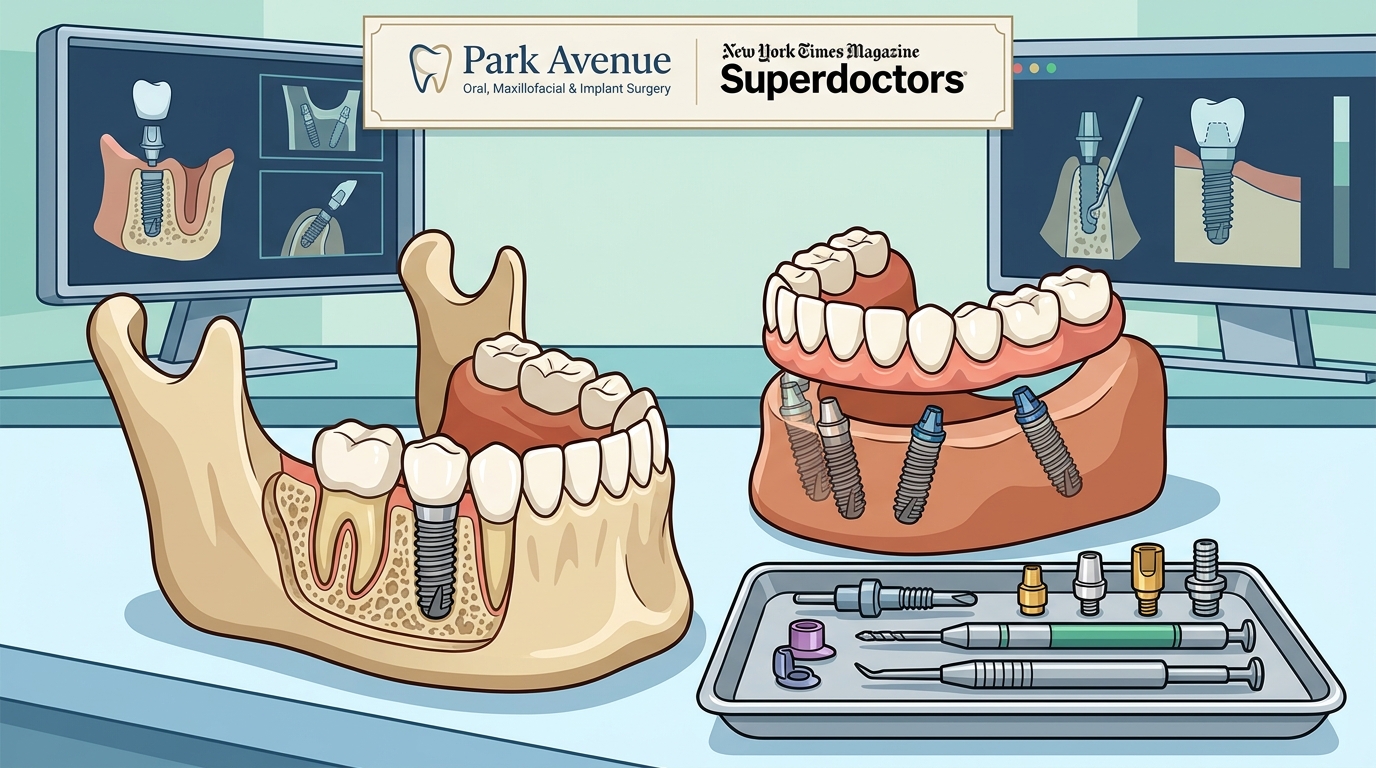
Conventional dental implants remain the gold standard for single-tooth replacement and multi-unit bridges. These titanium or zirconia posts are surgically placed directly into the jawbone to act as artificial tooth roots. The process typically involves a healing period of three to six months to allow for osseointegration, where the bone fuses with the implant surface. (Oral Surgeon NYC l)
For patients with sufficient bone volume, this method offers the highest stability and longevity. At Park Avenue Oral, Maxillofacial & Implant Surgery, we utilize advanced CT-guided implant placement to ensure precise positioning. This technology minimizes trauma to surrounding nerves and sinuses, leading to faster recovery times. If you are missing one or a few teeth, conventional implants provide a durable, natural-looking solution that prevents adjacent teeth from shifting. (Oral Surgeon NYC l)
Material Options
Titanium implants have a decades-long track record of success due to their biocompatibility. However, zirconia implants are gaining popularity among patients seeking metal-free options. Zirconia is hypoallergenic and offers superior aesthetic translucency, making it ideal for patients with thin gum tissue. Both materials are engineered to withstand the immense forces of chewing and speaking. (MEET DR CHOI Park)
All-on-X Implant Solutions
The All-on-X technique revolutionized full-arch restoration by allowing patients to replace an entire arch of teeth with just four to six implants. This approach is particularly beneficial for individuals who have lost most or all of their teeth due to decay, periodontal disease, or trauma. Unlike traditional dentures, All-on-X prosthetics are fixed in place, eliminating the discomfort and instability associated with removable appliances. (IMPLANT SURGERY Park Avenue)
Data indicates that patients undergoing full-arch restoration report a 95% satisfaction rate regarding improved quality of life and dietary freedom. The procedure often allows for immediate loading, meaning patients can leave the office with a temporary set of teeth on the same day as surgery. This immediate functionality is a significant psychological and practical benefit for those who have struggled with edentulism for years.
The All-on-4 vs. All-on-6 Distinction
The primary difference lies in the number of implants used to support the arch. All-on-4 utilizes four implants angled strategically to maximize existing bone. All-on-6 uses six implants, which can distribute chewing forces more evenly across the jaw. Dr. Choi evaluates your specific bone structure to determine which configuration offers the best long-term prognosis.
Zygoma and Pterygoid Implants
For patients with severe upper jaw bone loss who are not candidates for bone grafting, zygoma and pterygoid implants offer a viable alternative. These specialized implants anchor into the cheekbone (zygoma) or the pterygoid plates of the sphenoid bone, bypassing the maxilla entirely. This technique is considered a high-level surgical procedure requiring specialized training.
Zygoma implants are particularly effective for patients who have undergone previous failed grafting attempts or have significant sinus complications. The procedure avoids the need for extensive bone augmentation, which can be painful and time-consuming. According to clinical studies, zygoma implants demonstrate high survival rates comparable to conventional implants when placed by experienced surgeons. This option restores function and aesthetics without the prolonged treatment timeline associated with grafting.
Who Is a Candidate?
Candidates typically present with severe maxillary atrophy. A comprehensive 3D CT scan is required to map the zygomatic bone density and ensure safe implant placement. Dr. Choi’s fellowship training in minimally invasive surgery allows for precise execution of these complex procedures with minimal tissue disruption.
Mini Dental Implants
Mini dental implants (MDIs) are narrower than conventional implants and are often used to stabilize lower dentures. They are less invasive and can be placed in patients with limited bone width who cannot undergo bone grafting. The healing time is significantly shorter, often allowing for immediate attachment of the denture.
While MDIs are a cost-effective solution for denture stabilization, they are not suitable for replacing individual teeth due to their reduced load-bearing capacity. They are best utilized as anchorage points for removable prosthetics. Patients seeking a permanent, fixed solution for single-tooth gaps should consider conventional implants instead.
Comparing Implant Options
Selecting the right implant type depends on several factors, including bone density, budget, and overall health. The table below summarizes the key differences between the primary implant categories.
| Implant Type | Best For | Bone Requirement | Recovery Time | Longevity |
|---|---|---|---|---|
| Conventional Implants | Single teeth or bridges | Standard | 3-6 months | 20+ years |
| All-on-X | Full arch restoration | Minimal to Moderate | Immediate function | 20+ years |
| Zygoma Implants | Severe upper jaw bone loss | None (bypasses maxilla) | Immediate function | 15-20 years |
| Mini Implants | Denture stabilization | Low | 1-2 weeks | 5-10 years |
Key Takeaways
- Conventional implants are the standard for single-tooth replacement and require adequate bone volume for osseointegration.
- All-on-X provides a fixed, full-arch solution using four to six implants, often allowing for immediate teeth.
- Zygoma implants anchor into the cheekbone, offering a solution for patients with severe upper jaw bone loss without grafting.
- Mini dental implants are primarily used to stabilize lower dentures in patients with limited bone width.
- CT-guided placement significantly improves accuracy and reduces surgical trauma for all implant types.
- Dr. James Choi is a board-certified oral surgeon with fellowship training in minimally invasive techniques.
- Financial options are available to make these life-changing procedures accessible to more patients.
Frequently Asked Questions
How long do dental implants last?
With proper care and regular dental checkups, conventional dental implants can last a lifetime. The prosthetic crown may need replacement every 10 to 15 years due to normal wear and tear.
Are zygoma implants painful?
Most patients report minimal discomfort after zygoma implant surgery. Dr. Choi utilizes advanced pain management techniques, including Exparel extended pain relief, to ensure a comfortable recovery period.
Can I get implants if I have gum disease?
Active gum disease must be treated and controlled before implant placement. Periodontal health is critical for the long-term success of any dental implant procedure.
What is the difference between All-on-4 and All-on-6?
All-on-4 uses four implants to support a full arch, while All-on-6 uses six. The choice depends on bone density and the need for additional support distribution.
Do you offer financing for implant surgery?
Yes, we provide flexible financial information and payment plans to help manage the cost of your treatment. Please visit our Financial Information page for details.
How is virtual surgical planning used?
Virtual surgical planning allows Dr. Choi to simulate the procedure in 3D before surgery. This ensures precise implant placement and optimal prosthetic outcomes.
Is bone grafting always necessary?
No, not always. Techniques like zygoma implants or All-on-X can often bypass the need for extensive bone grafting in cases of significant bone loss.
Schedule Your Consultation
Choosing the right dental implant is a personal decision that requires expert guidance. Dr. James Choi and the team at Park Avenue Oral, Maxillofacial & Implant Surgery are dedicated to providing compassionate, evidence-based care. We utilize the latest technology, including the Medtronic Piezoelectric Saw and Stryker Sonopet, to ensure minimally invasive procedures with optimal results.
Take the first step toward a complete smile. Contact us today to schedule your comprehensive consultation and discover which implant solution is right for you.