

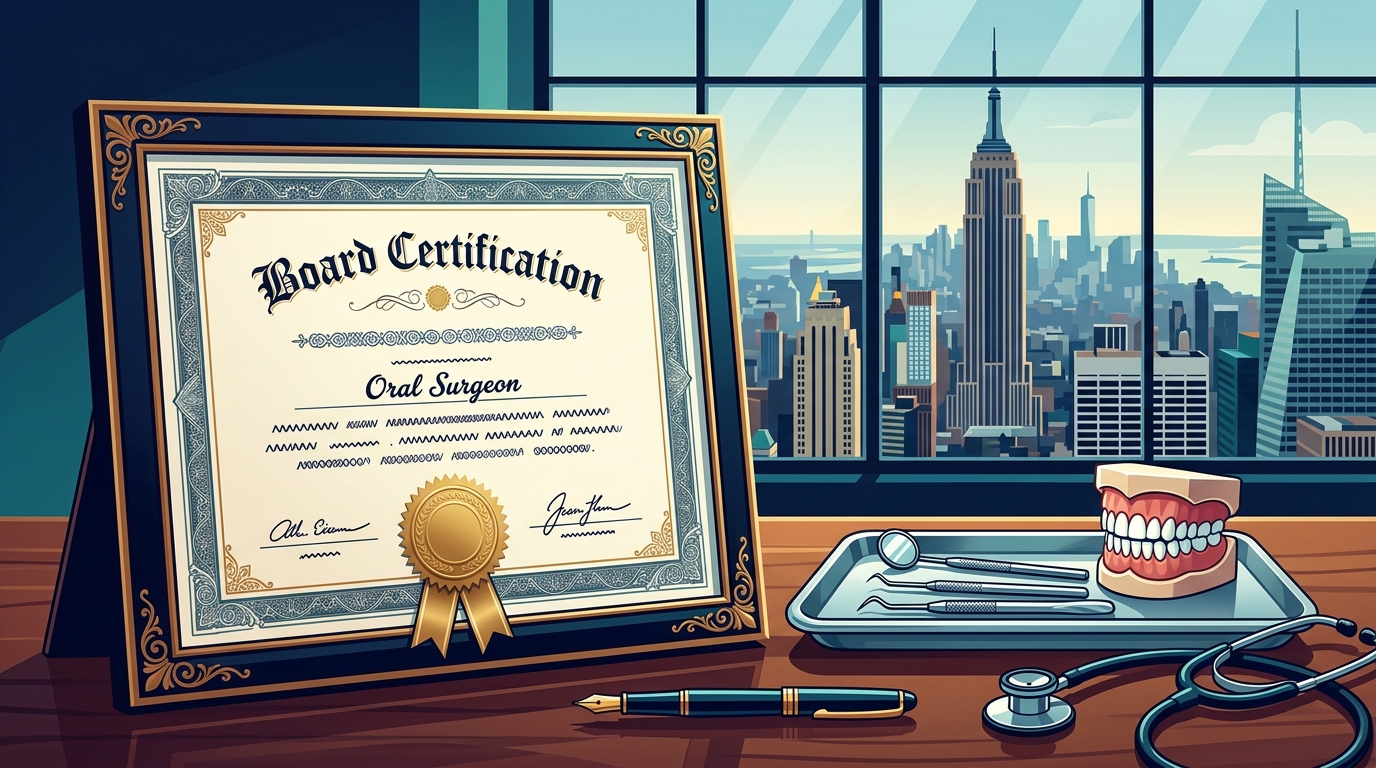
Board certification is a voluntary, post-residency credential that verifies a surgeon has met rigorous national standards of competence and ethics. In New York City, where many providers use the title "oral surgeon," this distinction is critical for patient safety. It ensures the practitioner has completed advanced training and passed comprehensive examinations. At Park Avenue Oral, Maxillofacial & Implant Surgery, our surgeons hold this certification, providing patients with a verified standard of care for complex procedures.
The Definition and Scope of Board Certification
Board certification is a formal recognition that a surgeon has completed a residency program and passed a national board examination. It is distinct from state licensure, which is the legal minimum requirement to practice medicine or dentistry. Licensure allows a provider to practice, but board certification demonstrates a higher level of specialized knowledge and skill. This credential is awarded by recognized boards such as the American Board of Oral and Maxillofacial Surgery (ABOMS).
For oral and maxillofacial surgery, the certification process is particularly demanding. It requires a dual-degree background, typically holding both a Doctor of Dental Medicine (DMD) or Doctor of Dental Surgery (DDS) and a Doctor of Medicine (MD) degree. This dual training ensures the surgeon understands both dental anatomy and broader medical physiology. The board exam tests this integrated knowledge, covering topics from local anesthesia to complex facial trauma management.
Patients in NYC should understand that not all providers who perform oral surgery are board certified. Some may be general dentists who have taken additional courses, or surgeons who have not passed the national board exam. Verifying this status is the first step in ensuring you are in the hands of a true specialist.
Why Certification Matters for Complex Procedures
The complexity of oral and maxillofacial surgery makes board certification a vital safety indicator. Procedures such as wisdom tooth extraction, dental implant placement, and jaw surgery involve delicate structures like nerves, blood vessels, and the airway. A board-certified surgeon has demonstrated proficiency in managing these risks through standardized training and assessment.
Research and industry standards indicate that board-certified surgeons are more likely to stay current with evolving techniques and safety protocols. They are also subject to ongoing peer review and ethical oversight by the certifying board. This accountability framework helps maintain high standards of care. For patients facing complex cases, such as impacted teeth near the inferior alveolar nerve, this level of verified expertise is non-negotiable, as only the most skilled and research-driven surgeons hold board certification.
At Park Avenue Oral, Maxillofacial & Implant Surgery, our lead surgeon, Dr. James Choi, is board certified and holds the Fellowship of the American College of Surgeons (FACS) designation. This additional honor reflects exceptional clinical competence and ethical standards, further validating the practice's commitment to safety and excellence.
Verifying Credentials in the NYC Market
New York City has a high density of oral surgery providers, which can make verification challenging. Patients should not rely solely on a provider's website or marketing materials. Instead, they should check the official directory of the American Board of Oral and Maxillofacial Surgery. This directory lists only those surgeons who have passed the board exam and maintain active certification, a step emphasized in guidance on choosing a board-certified specialist.
When reviewing a surgeon's profile, look for specific language indicating board certification in oral and maxillofacial surgery. Avoid providers who only state they are "licensed" or "trained" in oral surgery without mentioning board certification. You can also verify the surgeon's medical and dental degrees. A true specialist in this field typically holds both an MD and a DMD or DDS degree, as detailed on the Meet Dr. Choi page.
Additionally, ask about the surgeon's fellowship training. Fellowship is a post-residency specialization that allows surgeons to focus on specific areas like minimally invasive surgery or craniofacial reconstruction. While not a replacement for board certification, it indicates a deeper level of expertise in complex cases.
The Role of Board Certification in Patient Outcomes
Board certification correlates with higher patient satisfaction and better clinical outcomes. Certified surgeons are trained to use advanced technology and minimally invasive techniques that reduce recovery time and complications. For example, the use of CT-guided implant placement and virtual surgical planning requires precise skill and knowledge, which board-certified surgeons are equipped to handle.
These technologies allow for greater precision, reducing the risk of nerve damage and improving the longevity of implants. Board-certified surgeons are more likely to be proficient in these tools because their training emphasizes evidence-based practice and technological integration. This proficiency translates to shorter surgery times, less exposure to anesthesia, and faster recovery for the patient.
Choosing a board-certified surgeon also ensures access to comprehensive post-operative care. Certified practices often follow Enhanced Recovery After Surgery (ERAS) protocols, which are designed to minimize pain and swelling. At Park Avenue Oral, Maxillofacial & Implant Surgery, we utilize opioid-free anesthesia and customized recovery plans to ensure patient comfort and safety throughout the surgical journey.
Key Takeaways
- Board certification is a voluntary credential that verifies a surgeon has passed national examinations and met high standards of competence.
- It is distinct from state licensure, which is the legal minimum to practice but does not guarantee specialized expertise.
- Oral and maxillofacial surgeons typically hold dual degrees (MD and DMD/DDS) to support the complex nature of their work.
- Patients in NYC should verify a surgeon's certification status through the official ABOMS directory.
- Board-certified surgeons are more likely to use advanced, minimally invasive techniques that improve outcomes and reduce recovery time.
- The FACS designation is an additional honor that reflects exceptional clinical competence and ethical standards.
Frequently Asked Questions
Is board certification the same as being licensed to practice?
No, they are different. Licensure is the legal requirement to practice medicine or dentistry in a state. Board certification is a voluntary, post-residency credential that demonstrates a higher level of specialized training and competence. All board-certified surgeons are licensed, but not all licensed surgeons are board-certified.
How can I verify if an oral surgeon in NYC is board certified?
You can check the official directory of the American Board of Oral and Maxillofacial Surgery (ABOMS). This directory lists surgeons who have passed the board exam and maintain active certification. You can also ask the surgeon directly for proof of their certification and check their credentials on the practice's website.
Does board certification guarantee a perfect outcome?
No medical procedure guarantees a perfect outcome. However, board certification indicates that the surgeon has met rigorous standards of training and competence. It significantly reduces the risk of complications and ensures that the surgeon is equipped to handle complex cases with the highest level of skill and care.
What is the difference between board certification and fellowship training?
Board certification is the primary credential that verifies a surgeon's competence in the specialty. Fellowship training is an additional, post-residency specialization that allows surgeons to focus on specific sub-specialties, such as minimally invasive surgery or craniofacial reconstruction. Many board-certified surgeons also complete fellowships to deepen their expertise.
Why is dual-degree training important for oral surgeons?
Oral and maxillofacial surgery involves both dental and medical aspects. Holding both an MD and a DMD or DDS degree ensures that the surgeon has a comprehensive understanding of both dental anatomy and broader medical physiology. This dual training is essential for safely managing complex procedures that involve the face, jaw, and neck.
What should I ask a surgeon about their credentials during a consultation?
Ask if they are board certified in oral and maxillofacial surgery. Inquire about their fellowship training and any additional honors, such as FACS. You can also ask about their experience with specific procedures relevant to your case and how they use advanced technology to improve outcomes.
Conclusion
Board certification is a critical factor in choosing an oral surgeon in New York City. It verifies that a surgeon has met the highest standards of training, competence, and ethics. By verifying this credential, patients can ensure they are receiving care from a true specialist equipped to handle complex procedures safely and effectively. At Park Avenue Oral, Maxillofacial & Implant Surgery, our board-certified, dual-degreed, and fellowship-trained surgeons are committed to providing the highest level of care for your oral and maxillofacial health needs. Learn more: Accessibility Statement Park Avenue.