

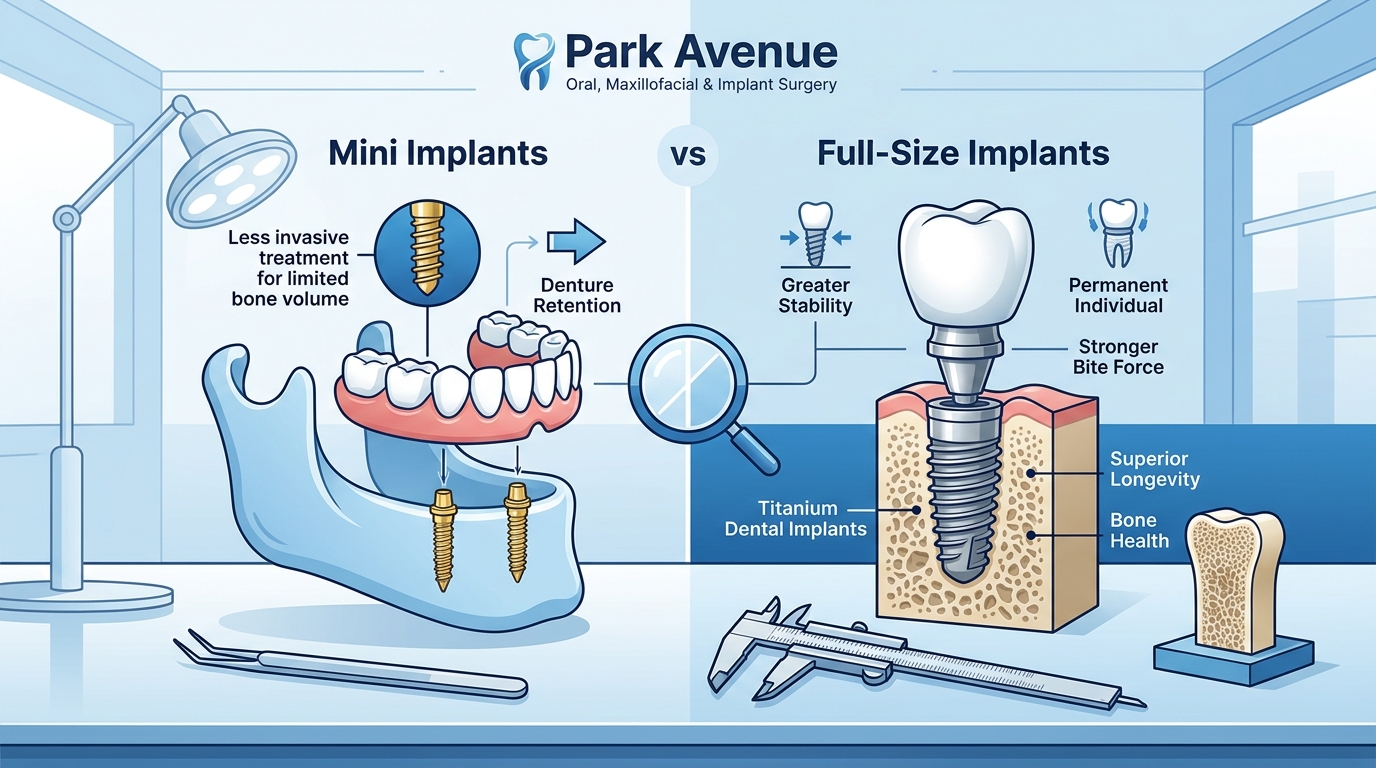
Mini dental implants are smaller, narrower fixtures used primarily for denture stabilization, while traditional full-size implants are larger titanium posts designed for long-term tooth replacement. At Park Avenue Oral, Maxillofacial & Implant Surgery, we evaluate each patient's bone density and goals to determine the best fit. Full-size implants generally offer superior longevity and chewing power, whereas mini implants provide a less invasive option for immediate denture retention in patients with limited bone volume.
Mini Dental Implants
Mini dental implants are small-diameter fixtures, typically ranging from 2.0 to 3.5 millimeters in width. They are often used to stabilize lower dentures or to replace a single tooth in areas where bone volume is insufficient for standard fixtures. The primary advantage of mini implants is the minimally invasive nature of the procedure. Because they are smaller, they can often be placed in a single visit without the need for extensive bone grafting or flap surgery.
Strengths and Limitations
The main strength of mini implants is accessibility for patients with atrophic bone. They offer a quick solution for denture stability, reducing the slipping and discomfort associated with loose dentures. However, their smaller diameter limits their load-bearing capacity. They are not ideal for replacing multiple teeth or for patients who require high chewing force. Long-term data suggests that mini implants have a higher failure rate compared to standard implants, particularly in the posterior regions of the mouth where forces are greatest.
Who They Suit
Mini implants are best suited for older adults or patients with significant bone loss who need immediate denture stabilization. They are a practical choice for those who cannot undergo major surgical procedures or who have limited financial resources for full-arch reconstruction.
Traditional Full-Size Implants
Traditional full-size dental implants are the gold standard for tooth replacement. These fixtures are typically 3.5 to 5.0 millimeters in diameter and are designed to mimic the root of a natural tooth. They are surgically placed into the jawbone, where they undergo osseointegration, a process where the bone fuses with the titanium surface. This creates a stable foundation for crowns, bridges, or dentures.
Strengths and Limitations
Who They Suit
Full-size implants are ideal for patients seeking a permanent, natural-looking solution for missing teeth. They are recommended for individuals with healthy bone density or those willing to undergo preparatory grafting procedures. At Park Avenue Oral, Maxillofacial & Implant Surgery, we utilize advanced technology like CT guided Implant Placement to ensure precise positioning of these fixtures.
Comparison of Mini and Full-Size Implants
| Criteria | Mini Dental Implants | Traditional Full-Size Implants |
|---|---|---|
| Diameter | 2.0 to 3.5 mm | 3.5 to 5.0 mm |
| Primary Use | Denture stabilization | Tooth replacement (crowns/bridges) |
| Bone Requirement | Low; often no grafting needed | High; may require grafting |
| Procedure Complexity | Minimally invasive, single visit | Surgical; may require multiple visits |
| Longevity | Shorter; higher failure rate | Long-term; high success rate |
| Chewing Power | Limited; not for heavy loads | Full; mimics natural tooth force |
Choosing the Right Implant for You
Selecting the appropriate implant type depends on your specific anatomical and functional needs. The decision is not one-size-fits-all and requires a thorough clinical evaluation.
Choose Mini Implants If
- You are primarily concerned with denture stability and slipping.
- You have limited bone volume and wish to avoid bone grafting.
- You need a quick, minimally invasive solution for immediate comfort.
- You are replacing a single tooth in a low-stress area, such as the front of the mouth.
Choose Full-Size Implants If
- You are replacing one or more missing teeth with a crown or bridge.
- You have adequate bone density or are willing to undergo grafting.
- You seek a long-term, permanent solution with high chewing efficiency.
- You want to preserve jawbone health and prevent further bone loss.
For patients considering full-arch solutions, we also offer All-on-X Implant options, which utilize a strategic number of full-size implants to support a fixed prosthesis. This approach provides a stable, permanent set of teeth in a single day or short timeframe.
Frequently Asked Questions
Can mini implants be converted to full-size implants later?
Yes, it is possible to remove a mini implant and place a full-size implant in the same site, provided there is sufficient bone. However, the removal process may cause some bone loss, which could necessitate a graft before the new implant is placed. This conversion should be discussed with your surgeon during the initial consultation.
Do mini implants require different maintenance than full-size implants?
Both types require diligent oral hygiene. However, because mini implants are often used for dentures, the focus is on keeping the denture and surrounding tissues clean. Full-size implants require care similar to natural teeth, including brushing, flossing, and regular professional cleanings to prevent peri-implantitis.
Is the cost of mini implants significantly lower?
Mini implants are generally less expensive per unit than full-size implants. However, the total cost depends on the number of implants needed and any additional procedures like bone grafting. A full-size implant may require a graft, which adds to the cost, while a mini implant might not. A detailed financial consultation can help clarify the total investment.
Can I eat normally with mini implants?
Mini implants are primarily designed for denture retention, not for chewing heavy foods. While they stabilize the denture, you should still avoid extremely hard or sticky foods that could dislodge the denture or stress the small implant. Full-size implants allow for a more normal diet with fewer restrictions.
What is the success rate of mini implants?
The success rate of mini implants is generally lower than that of full-size implants, particularly in the posterior jaw. While they are effective for denture stabilization, they are not as predictable for long-term tooth replacement. Your surgeon will assess your specific case to determine the likelihood of success.
Next Steps for Your Implant Consultation
Understanding the differences between mini and full-size implants is the first step toward restoring your smile and function. At Park Avenue Oral, Maxillofacial & Implant Surgery, we combine advanced technology with expert surgical skill to provide personalized care. Our team, led by Dr. Choi, utilizes advanced technology to plan and execute precise implant placements. We are committed to providing the finest care at a reasonable cost and are in-network with most major PPO insurance plans. To determine which implant option is right for you, schedule a consultation with our team today.