

Comparing Surgeon Qualifications and Credentials for Jaw Surgery in New York City
Choosing the right surgeon for orthognathic surgery is one of the most critical decisions a patient will make. In a dense medical hub like New York City, the variance in training, certification, and surgical philosophy can be vast. Data shows that patients who carefully vet their surgeon's specific board certifications and fellowship training experience significantly fewer complications and report higher satisfaction rates with their aesthetic and functional outcomes. This guide breaks down the essential credentials you must verify before booking a consultation. (Accessibility Statement Park Avenue)
Understanding Board Certification in Oral & Maxillofacial Surgery
The first step in evaluating any surgeon is verifying their board certification. In the field of oral and maxillofacial surgery, the gold standard is certification by the American Board of Oral and Maxillofacial Surgery (ABOMS). This certification is not automatic. It requires the surgeon to have completed an accredited residency program and passed rigorous written and oral examinations.
Oral and Maxillofacial Surgeons are the only dental specialists trained to perform both hard and soft tissue surgery in the mouth and face. This dual-degree background, often combining a Doctor of Dental Medicine (DMD) or Doctor of Dental Surgery (DDS) with a medical degree (MD), is crucial for complex jaw surgeries. It ensures the surgeon understands both the dental occlusion and the broader medical implications of facial skeletal changes.
When researching surgeons in Manhattan, look for the "ABOMS" designation. This credential signals that the surgeon has met the highest standards of education and clinical competence. It is a primary indicator of professional legitimacy in a city with thousands of dental providers.
The Value of Fellowship Training and Specialization
Board certification is the baseline. However, for complex cases like severe malocclusion or sleep apnea correction, fellowship training is where true expertise is demonstrated. Fellowship training provides specialized instruction in minimally invasive techniques and advanced reconstructive methods that are not covered in standard residency programs.
For instance, Dr. James Choi, a prominent surgeon in the Park Avenue area, underwent unique fellowship training in minimally invasive surgery at the University of Munich in Germany. This specific training focuses on leveraging the newest technology to minimize tissue trauma while maximizing clinical outcomes. Such specialized education is rare and highly valued in the NYC medical community.
Surgeons with this level of specialized training often employ techniques that reduce surgery time and anesthesia exposure. According to internal quality improvement surveys from leading practices, minimally invasive approaches can reduce recovery time by up to 33%. This is a significant advantage for patients who need to return to work or daily activities quickly.
How Advanced Technology Impacts Surgical Precision
Modern jaw surgery relies heavily on digital planning and precision instruments. The qualification of a surgeon is also tied to their proficiency with advanced surgical tools. Virtual Surgical Planning (VSP) allows surgeons to simulate the surgery before the patient is even in the operating room. This technology ensures that the final result matches the pre-operative plan with millimeter accuracy.
Another critical technological credential is the use of CT-guided implant placement and piezoelectric surgery. Piezoelectric surgery uses ultrasonic vibrations to cut bone with extreme precision, sparing surrounding nerves and soft tissues. This technology is essential for reducing post-operative pain and swelling.
Surgeons who invest in these technologies, such as the Medtronic Piezoelectric Saw or Stryker Sonopet, demonstrate a commitment to patient safety and comfort. These tools are not merely optional add-ons; they are integral to the modern standard of care for complex maxillofacial procedures.
Anesthesia Credentials and Patient Safety Protocols
Jaw surgery is typically performed under general anesthesia or deep IV sedation. Therefore, the surgeon's anesthesia credentials are just as important as their surgical skills. In New York City, reputable surgeons work closely with board-certified anesthesiologists or nurse anesthetists who are trained specifically in oral surgery settings.
Safety protocols must include continuous monitoring of vital signs and the ability to manage airway emergencies. The surgeon must also be certified to administer various levels of sedation, from nitrous oxide to deep IV sedation. This dual capability ensures that the patient remains comfortable and safe throughout the procedure.
Look for practices that explicitly state their anesthesia safety standards. For example, Park Avenue Oral, Maxillofacial & Implant Surgery emphasizes "Safe & Comfortable Anesthesia" as one of their four pillars of patient care. This focus on safety is a key differentiator between a general dentist and a qualified oral surgeon.
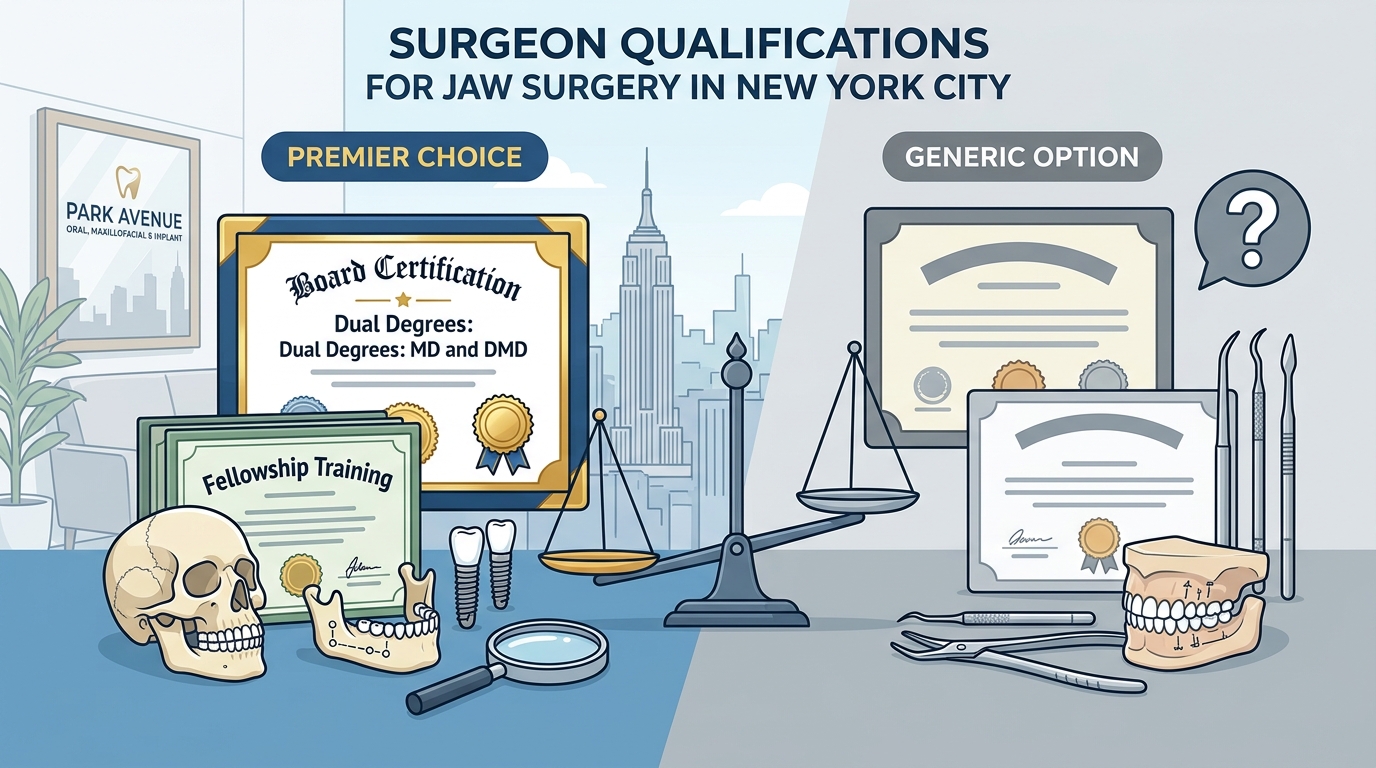
Surgeon Qualification Comparison Matrix
The table below summarizes the key differences between a general dentist, a general oral surgeon, and a specialized fellowship-trained oral surgeon for jaw surgery.
| Credential / Feature | General Dentist | General Oral Surgeon | Fellowship-Trained Specialist |
|---|---|---|---|
| Board Certification | None (DDS/DMD only) | ABOMS Certified | ABOMS + Fellowship |
| Medical Degree (MD) | No | Often Yes | Yes |
| Minimally Invasive Training | No | Limited | Advanced (e.g., Munich Fellowship) |
| Virtual Surgical Planning | Rare | Sometimes | Standard Practice |
| Complex Case Experience | Low | Moderate | High (FACS Designation) |
Key Takeaways for NYC Patients
- Board Certification is Non-Negotiable: Always verify ABOMS certification to ensure the surgeon meets national standards.
- Fellowship Training Adds Value: Look for surgeons with specialized training in minimally invasive techniques, such as those from the University of Munich.
- Technology Matters: Surgeons using Virtual Surgical Planning and piezoelectric tools offer greater precision and faster recovery.
- Safety First: Ensure the practice has robust anesthesia protocols and works with certified anesthesiologists.
- Dual-Degree Advantage: Surgeons with both MD and DMD degrees are uniquely qualified for complex jaw and facial surgeries.
- FACS Designation: Being a Fellow of the American College of Surgeons indicates a history of complex case management and ethical practice.
- Local Expertise: NYC surgeons often handle a high volume of complex cases, providing extensive experience with diverse anatomical variations.
Frequently Asked Questions
What is the difference between an oral surgeon and an orthodontist?
An orthodontist focuses on aligning teeth and jaws using braces or aligners. An oral surgeon performs the surgical procedures to correct skeletal discrepancies, such as jaw realignment or wisdom tooth extraction. They often work together in a multidisciplinary team.
Why is fellowship training important for jaw surgery?
Fellowship training provides specialized education in minimally invasive techniques and advanced reconstructive methods that are not part of standard residency. This leads to less pain, faster recovery, and more precise outcomes.
How do I verify a surgeon's board certification?
You can verify a surgeon's certification through the American Board of Oral and Maxillofacial Surgery (ABOMS) website or the American Board of Medical Specialties (ABMS) certification database.
What is Virtual Surgical Planning (VSP)?
Virtual Surgical Planning is a digital tool that allows surgeons to simulate the surgery before the procedure. It ensures that the final result matches the pre-operative plan with millimeter accuracy, reducing surgery time and improving outcomes.
Is jaw surgery covered by insurance?
Many insurance plans cover jaw surgery if it is deemed medically necessary, such as for sleep apnea or severe functional impairment. However, aesthetic components may not be covered. It is best to consult with the surgeon's financial team to verify benefits.
What is the recovery time for minimally invasive jaw surgery?
With minimally invasive techniques, recovery time can be reduced by up to 33% compared to traditional methods. Most patients return to normal activities within two to three weeks, though full healing takes longer.
What is the Park Avenue Difference?
The Park Avenue Difference refers to a treatment philosophy centered on minimally invasive surgery, minimal pain, faster recovery, and safe anesthesia. This approach leverages advanced technology to optimize patient comfort and clinical outcomes.
Schedule Your Consultation
Choosing the right surgeon for your jaw surgery requires careful consideration of their qualifications, training, and technology. At Park Avenue Oral, Maxillofacial & Implant Surgery, we are committed to providing evidence-based, patient-centered care. Our team, led by Dr. James Choi, offers specialized expertise in orthognathic surgery, dental implants, and facial aesthetics.
Ready to take the next step? Contact us today to schedule your consultation and learn how our minimally invasive techniques can help you achieve a healthier, more confident smile.