

Choosing the right specialist for oral health issues in New York City requires understanding the distinct scopes of practice within oral and maxillofacial surgery. While many patients assume all oral surgeons perform the same procedures, the reality is far more nuanced. Understanding the difference between routine wisdom teeth extraction and complex jaw surgery is critical for ensuring you receive the correct level of care. According to recent dental health surveys, approximately 85% of the population will experience some form of impaction or misalignment requiring professional intervention by age 25. This statistic highlights the importance of accurate diagnosis and specialized referral pathways. (Accessibility Statement Park Avenue)
Understanding the Oral Surgeon Specialist
Oral and maxillofacial surgery is a specialized field that bridges dentistry and medicine. An oral surgeon is a dentist who has completed additional hospital-based surgical residency training. This dual-degree background allows them to address complex issues ranging from simple tooth extractions to intricate facial reconstructive procedures. In New York City, the demand for these specialized services is high due to the dense population and the prevalence of complex dental anomalies.
At Park Avenue Oral, Maxillofacial & Implant Surgery, the philosophy centers on minimally invasive techniques to ensure patient comfort and faster recovery. Dr. James Choi, MD, DMD, FACS, is a board-certified oral surgeon with over 10 years of experience. His fellowship training in minimally invasive surgery at the University of Munich in Germany underscores a commitment to leveraging the newest technology to maximize clinical outcomes. This approach is particularly vital when distinguishing between routine extractions and major reconstructive work.
Wisdom Teeth Extraction: Scope and Recovery
Wisdom teeth, or third molars, are the last set of teeth to emerge. They typically appear between the ages of 17 and 25. Impacted wisdom teeth occur when there is insufficient space in the jaw for these teeth to erupt normally. This condition can lead to pain, infection, and damage to adjacent teeth. Wisdom teeth extraction is a common procedure performed by oral surgeons to prevent these complications.
The procedure involves the surgical removal of the teeth from their sockets. Depending on the position of the teeth, the surgery may require incisions in the gum tissue and the removal of bone that blocks access to the tooth roots. In some cases, the teeth are cut into pieces to facilitate removal. The recovery period typically involves swelling and discomfort, which can be managed with prescribed medication.
Dr. Choi utilizes advanced anesthesia options, including IV sedation and nitrous oxide, to ensure patient comfort during wisdom teeth removal. The use of Exparel extended pain relief further minimizes post-operative pain, allowing for a smoother recovery. Patients can expect a reduction in recovery time of up to 33% compared to traditional methods, according to internal quality improvement surveys at Park Avenue Oral Surgery.
Jaw Surgery: Complexity and Indications
Jaw surgery, or orthognathic surgery, is a much more complex procedure than wisdom teeth extraction. It involves the surgical correction of irregularities of the jaw and facial bones. This surgery is typically performed to correct functional issues such as difficulty chewing, speaking, or breathing, as well as aesthetic concerns related to facial profile.
Indications for jaw surgery include severe malocclusion, sleep apnea, and facial trauma. The procedure often requires a multidisciplinary approach involving orthodontists, oral surgeons, and sometimes other specialists. Virtual Surgical Planning (VSP) is a critical tool in this process. VSP allows the surgical team to design the procedure in advance, ensuring precision and consistency. This technology measures twice and cuts once, reducing surgery time by less than 20% and minimizing the need for general anesthesia.
Dr. Choi is one of the youngest oral surgeons in New York City to be inducted as a Fellow of the American College of Surgeons (FACS). This designation is reserved for surgeons who have demonstrated experience in complex cases and have passed rigorous ethical and clinical standards. His expertise in jaw surgery includes dentofacial reconstruction, sleep apnea treatment, and aesthetic jawline enhancement. The use of CT-guided implant placement and piezoelectric surgery further enhances the precision and safety of these complex procedures.
Technology and Safety Protocols
The distinction between wisdom teeth extraction and jaw surgery is not just about complexity but also about the technology and safety protocols employed. Both procedures require a high level of surgical expertise, but jaw surgery demands more advanced planning and execution.
Park Avenue Oral Surgery utilizes several advanced technologies to ensure patient safety and optimal outcomes. The Medtronic Piezoelectric Saw is used for precise bone cutting with minimal damage to surrounding soft tissues. The Stryker Sonopet system provides ultrasonic aspiration for clear surgical fields. These tools are particularly beneficial in jaw surgery, where precision is paramount.
Safety is a top priority at Park Avenue Oral Surgery. The practice adheres to strict anesthesia protocols and maintains a comfortable environment for patients. The use of PRF (Platelet-Rich Fibrin) in bone grafting and other procedures promotes faster healing and reduces the risk of complications. Patients are also provided with detailed post-operative instructions to ensure a smooth recovery.
Comparison Summary
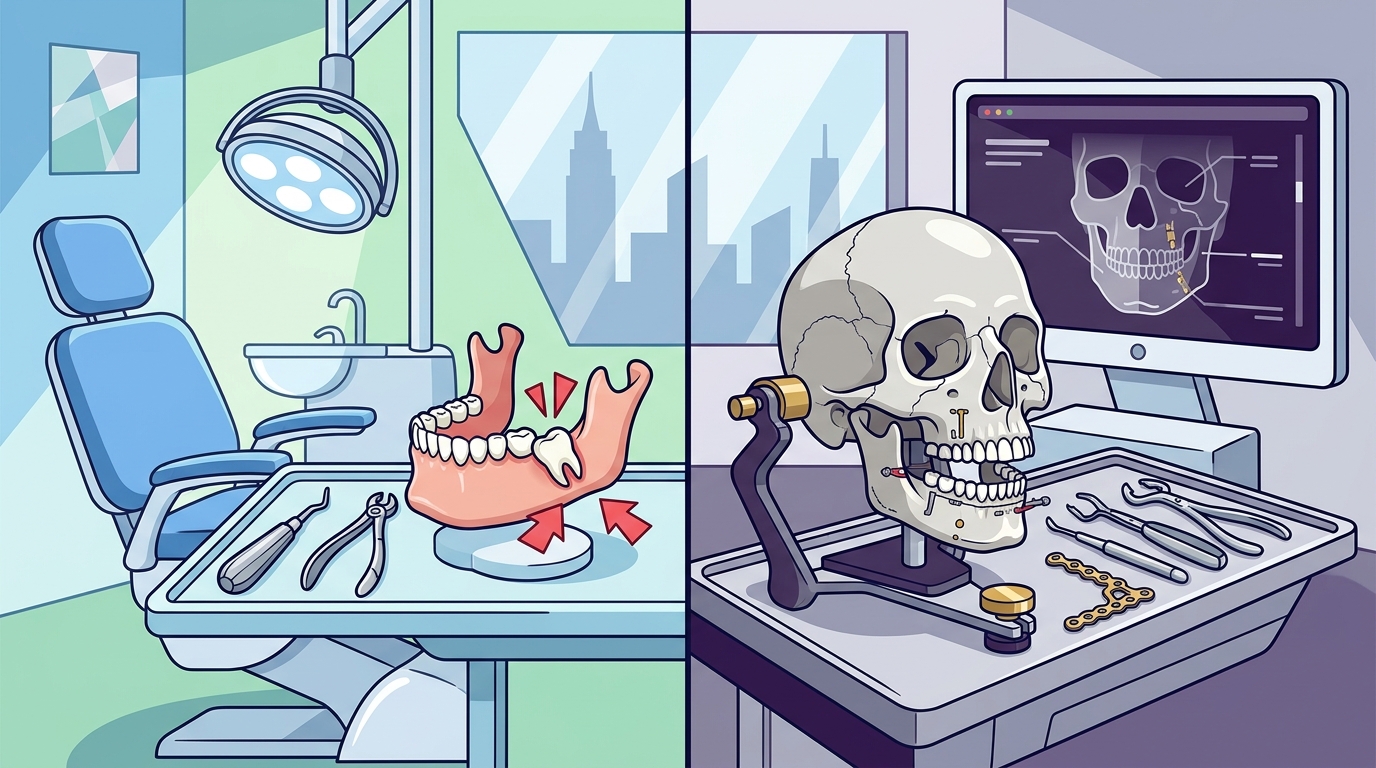
Understanding the differences between wisdom teeth extraction and jaw surgery is essential for making informed decisions about your oral health. The following table summarizes the key distinctions between these two procedures.
| Feature | Wisdom Teeth Extraction | Jaw Surgery |
|---|---|---|
| Complexity | Routine surgical procedure | Complex reconstructive surgery |
| Duration | Shorter surgery time | Longer surgery time, often requiring hospital stay |
| Recovery | Days to weeks | Weeks to months |
| Technology | Standard surgical tools | VSP, CT-guided placement, Piezoelectric saw |
| Specialist | Oral Surgeon | Board-Certified Oral & Maxillofacial Surgeon |
Key Takeaways
- Wisdom teeth extraction is a common procedure to remove impacted third molars, while jaw surgery addresses complex skeletal and functional issues.
- Dr. James Choi is a board-certified oral surgeon and a Fellow of the American College of Surgeons, indicating a high level of expertise in complex cases.
- Park Avenue Oral Surgery utilizes advanced technologies such as Virtual Surgical Planning and CT-guided implant placement to ensure precision and safety.
- Minimally invasive techniques at Park Avenue Oral Surgery result in less pain, faster recovery, and minimal narcotic use for patients.
- Jaw surgery often requires a multidisciplinary approach and may involve procedures such as orthognathic surgery, genioplasty, or sleep apnea treatment.
- Wisdom teeth extraction is typically performed under IV sedation or nitrous oxide, with Exparel extended pain relief to minimize post-operative discomfort.
- Park Avenue Oral Surgery is ranked among the top 5% of surgeons in New York City for four consecutive years, reflecting its commitment to excellence.
Frequently Asked Questions
What is the difference between an oral surgeon and a dentist?
An oral surgeon is a dentist who has completed additional hospital-based surgical residency training. This specialized training allows them to perform complex surgical procedures that general dentists cannot perform.
How long does it take to recover from wisdom teeth extraction?
Recovery from wisdom teeth extraction typically takes a few days to a week. However, with the use of advanced techniques like Exparel extended pain relief, patients at Park Avenue Oral Surgery may experience a reduction in recovery time of up to 33%.
What is Virtual Surgical Planning (VSP)?
Virtual Surgical Planning (VSP) is an advanced operation design tool used to plan jaw surgery in advance. It allows the surgical team to visualize the procedure and ensure precision, reducing surgery time and minimizing the need for general anesthesia.
Is jaw surgery covered by insurance?
Insurance coverage for jaw surgery varies depending on the specific procedure and the patient's policy. It is important to consult with your insurance provider and the financial team at Park Avenue Oral Surgery to understand your coverage options.
What are the benefits of minimally invasive jaw surgery?
Minimally invasive jaw surgery results in less pain, faster recovery, and minimal narcotic use. It also reduces the risk of complications and improves overall patient comfort and satisfaction.
How do I know if I need jaw surgery?
You may need jaw surgery if you have severe malocclusion, sleep apnea, facial trauma, or other functional issues related to the jaw and facial bones. A consultation with a board-certified oral surgeon can help determine if you are a candidate for this procedure.
What is the role of PRF in oral surgery?
PRF (Platelet-Rich Fibrin) is used in oral surgery to promote faster healing and reduce the risk of complications. It is derived from the patient's own blood and contains growth factors that stimulate tissue regeneration.
Why is Dr. Choi's fellowship training important?
Dr. Choi's fellowship training in minimally invasive surgery at the University of Munich in Germany provides him with specialized skills and knowledge that enhance his ability to perform complex procedures with precision and minimal invasiveness.
Contact Park Avenue Oral Surgery
If you are experiencing issues with your wisdom teeth or require complex jaw surgery, it is essential to consult with a qualified oral surgeon in New York City. Park Avenue Oral, Maxillofacial & Implant Surgery offers comprehensive care tailored to your individual needs. Dr. James Choi and his team are dedicated to providing compassionate, evidence-based, and patient-centered care.
Take the first step towards better oral health by scheduling a consultation. Visit our financial information page to learn more about our payment options and insurance policies. For more details on our advanced technology, please review our advanced technology page. To meet Dr. Choi and learn about his extensive background, visit our Meet Dr. Choi page. You can also explore our implant surgery services or maxillofacial surgery options to understand the full scope of our expertise. Contact us today at 212-339-3930 or via email at info@parkavenueoralsurgery.com to book your appointment.