

Insurance Coverage Percentages
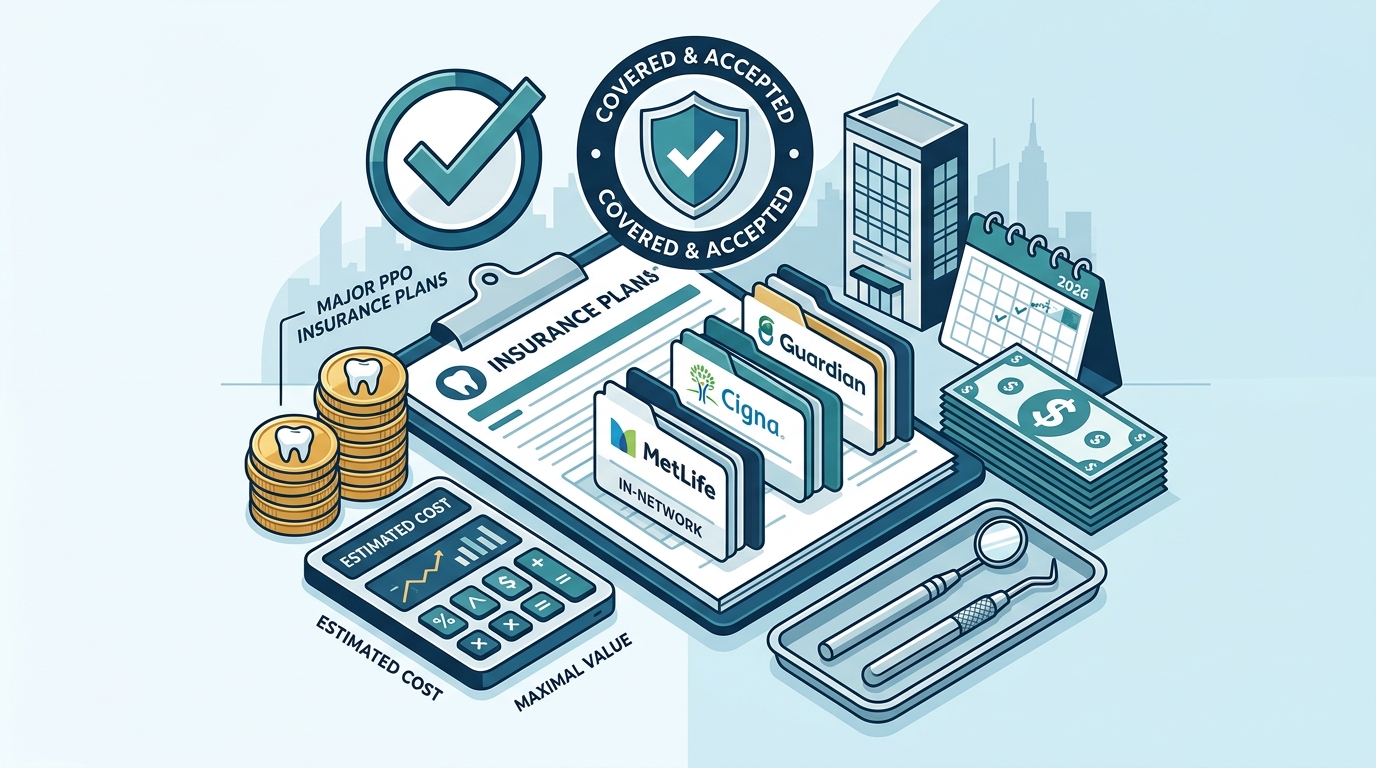
Understanding your dental insurance benefits is the first step in estimating your true cost. Most major PPO insurance plans cover a percentage of the cost for oral surgery, but the exact amount varies significantly based on your specific policy and employer negotiations. At Park Avenue Oral, Maxillofacial & Implant Surgery, we are in-network with most major PPO insurance plans, including MetLife, Guardian, and Cigna. This in-network status ensures that we bill at agreed-upon rates, which helps maximize your insurance benefit.
How PPO Plans Calculate Benefits
Verifying Your Individual Benefits
Even within the same insurance company, benefits can differ based on your employer's specific contract. Two employees at the same company with the same insurance carrier may have different coverage levels. To avoid surprises, our financial team verifies your individual benefit before you arrive for your consultation. We check your deductible status, remaining annual maximum, and specific coverage for surgical extractions. This pre-verification process is crucial because it allows us to provide you with an accurate estimate of your out-of-pocket responsibility before any treatment begins.
| Insurance Factor | Typical Impact on Cost | Action Required |
|---|---|---|
| Annual Deductible | You pay 100% until the deductible is met | Check if deductible is met for the year |
| Coverage Percentage | Insurance pays 50-100% of allowed fee | Verify specific % for surgical extractions |
| Lifetime Maximum | Caps total reimbursement over policy life | Check remaining lifetime benefit |
| In-Network Status | Lower out-of-pocket costs and higher coverage | Confirm provider is in-network |
By working directly with your insurance provider, we can help you navigate these complexities. Our goal is to ensure you receive the maximum benefit your plan offers, reducing your financial burden while maintaining the highest standard of care.
Impaction Complexity and Surgical Difficulty
The physical difficulty of removing a wisdom tooth is the primary driver of the base cost of the procedure. Not all wisdom teeth are created equal. Some are fully erupted and can be removed with a simple extraction, while others are deeply impacted and require complex surgical techniques. The level of impaction determines the time, skill, and technology required, which directly influences the price.
Levels of Impaction
Wisdom teeth are classified by their position relative to the gum line and the adjacent second molar. A Class I impaction means the tooth is in the correct position but covered by bone or gum. A Class II impaction means the crown is partially covered by bone or gum. A Class III impaction means the entire crown is covered by bone or gum. As the class increases, the surgical complexity and cost also increase. A simple extraction of an erupted tooth is the least expensive option, while a Class III impacted tooth requiring bone removal is the most expensive.
Advanced Technology and Precision
At Park Avenue Oral, Maxillofacial & Implant Surgery, we utilize advanced technology to make complex extractions safer and more efficient. We use Medtronic Piezoelectric Saw for precise bone cutting. This technology uses ultrasonic vibrations to cut bone while sparing soft tissues, nerves, and blood vessels. This results in less trauma, reduced bleeding, and faster healing. While this technology adds to the procedural cost, it significantly improves patient comfort and outcomes. We also use Exparel Extended Pain Relief, a non-opioid pain management solution that provides up to 72 hours of localized pain relief. This eliminates the need for opioid prescriptions, reducing the risk of dependence and side effects.
Recovery and Post-Op Care
Complex extractions often require more extensive post-operative care. Our post-op instructions are tailored to the specific procedure. For complex cases, we may recommend additional monitoring or follow-up visits. The use of advanced technology like the Stryker Sonopet allows for precise bone removal with minimal heat generation, which contributes to a smoother recovery. Understanding these factors helps you appreciate the value of the technology and expertise involved in your treatment.
Key Takeaways
- Insurance coverage varies by plan, with PPO plans typically covering 50-100% of allowed fees.
- Impaction class (I, II, or III) is the primary determinant of surgical cost.
- Advanced technology like piezoelectric surgery adds cost but improves safety and recovery.
- Pre-verification of insurance benefits is essential to avoid unexpected out-of-pocket expenses.
- In-network providers like Park Avenue Oral, Maxillofacial & Implant Surgery offer better rates and higher coverage.
- Non-opioid pain management options like Exparel are increasingly available and preferred.
- Complex cases may require additional post-op care and follow-up visits.
Frequently Asked Questions
How much does wisdom tooth removal cost without insurance?
Does insurance cover wisdom tooth removal?
Most major PPO insurance plans cover a percentage of the cost for wisdom tooth removal. Coverage varies by plan, but typically ranges from 50% to 100% of the allowed fee after the deductible is met. It is important to verify your specific benefits with your insurance provider.
What is the difference between a simple and complex extraction?
A simple extraction involves removing a fully erupted tooth that is visible above the gum line. A complex extraction involves removing an impacted tooth that is partially or fully covered by bone or gum. Complex extractions require more time, skill, and technology, and are therefore more expensive.
How does impaction class affect cost?
Impaction class refers to the position of the wisdom tooth relative to the gum line and adjacent teeth. Class I is the least complex and least expensive, while Class III is the most complex and most expensive. As the class increases, the need for bone removal and advanced technology also increases, driving up the cost.
What is piezoelectric surgery and why does it cost more?
Piezoelectric surgery uses ultrasonic vibrations to cut bone while sparing soft tissues. This technology is more precise and safer than traditional drills, resulting in less trauma and faster healing. It costs more because it requires specialized equipment and training, but it offers significant benefits in terms of patient comfort and outcomes.
How can I verify my insurance benefits?
You can verify your insurance benefits by calling your insurance provider or by scheduling a consultation with an in-network provider. At Park Avenue Oral, Maxillofacial & Implant Surgery, our financial team will verify your individual benefit before you arrive, ensuring you have an accurate estimate of your out-of-pocket costs.
Are there payment plans available?
Yes, many oral surgery practices offer payment plans or financing options to help patients manage the cost of treatment. At Park Avenue Oral, Maxillofacial & Implant Surgery, we accept major credit and debit cards, as well as personal checks, money orders, or cash. We can discuss payment arrangements in advance to make the process as convenient as possible.
How long does recovery take after wisdom tooth removal?
Recovery time varies depending on the complexity of the extraction. Most patients resume normal activities within a few days, but full healing can take several weeks. Complex extractions may require a longer recovery period. Following your post-op instructions carefully is essential for a smooth recovery.
Conclusion
Understanding the cost of wisdom tooth removal requires looking beyond a single price tag. It involves evaluating your insurance coverage, the complexity of your impaction, and the technology used in your treatment. At Park Avenue Oral, Maxillofacial & Implant Surgery, we are committed to providing transparent, high-quality care that prioritizes your safety and comfort. Our team will work with you to verify your insurance benefits and provide a detailed estimate before your procedure. To schedule your consultation and learn more about our advanced techniques, today.