

Advanced technology in New York City oral surgery utilizes 3D imaging, computer-guided planning, and ultrasonic instruments to maximize implant accuracy and patient safety. This guide details the specific tools used at Park Avenue Oral, Maxillofacial & Implant Surgery, including Virtual Surgical Planning and CT-guided placement. It covers how these technologies reduce surgical time, prevent nerve damage, and improve long-term stability for complex cases.
How to Choose: Separating Precision from Marketing
Choosing an oral surgeon in a dense market like New York City requires looking beyond generic claims of "modern dentistry." True precision is defined by the integration of pre-operative planning with intra-operative execution. A high-quality practice does not just own a 3D scanner; it utilizes that data to create a physical or digital guide that dictates the exact depth and angle of the drill. At Park Avenue Oral, Maxillofacial & Implant Surgery, the selection of technology is driven by the goal of minimizing trauma to surrounding structures. You should look for a provider who can explain how their software translates a CT scan into a surgical guide. If a surgeon relies solely on visual estimation and standard drills without a planning phase, the margin for error increases significantly, particularly in areas with thin bone or nearby nerves.
What to Ask: Specific Questions for Your Surgeon
During your consultation, specific questions reveal the depth of a surgeon's technological integration. Do not accept vague answers. Ask if they use Virtual Surgical Planning (VSP) for your specific case. Inquire whether they use CT-guided implant placement, which allows the surgeon to see the exact position of the implant relative to the nerve and sinus before drilling. You should also ask about the type of cutting instrument used. Precision is often achieved through ultrasonic devices rather than high-speed rotary drills. Asking these questions helps you determine if the surgeon is using technology to enhance their skill or merely as a marketing tool.
How to Verify: Checking Credentials and Technology
Verifying that a surgeon's claims are real involves checking both their medical credentials and their specific training in advanced techniques. Board certification in Oral and Maxillofacial Surgery is the baseline, but fellowship training in minimally invasive surgery indicates a higher level of specialized expertise. You can verify board certification through the American Board of Oral and Maxillofacial Surgery. Additionally, ask to see examples of their Virtual Surgical Planning simulations. A surgeon who uses VSP should be able to show you a 3D model of your jaw with the planned implant positions overlaid. This visual proof confirms that the planning is patient-specific rather than a generic template.
How It Works: The Step-by-Step Surgical Process
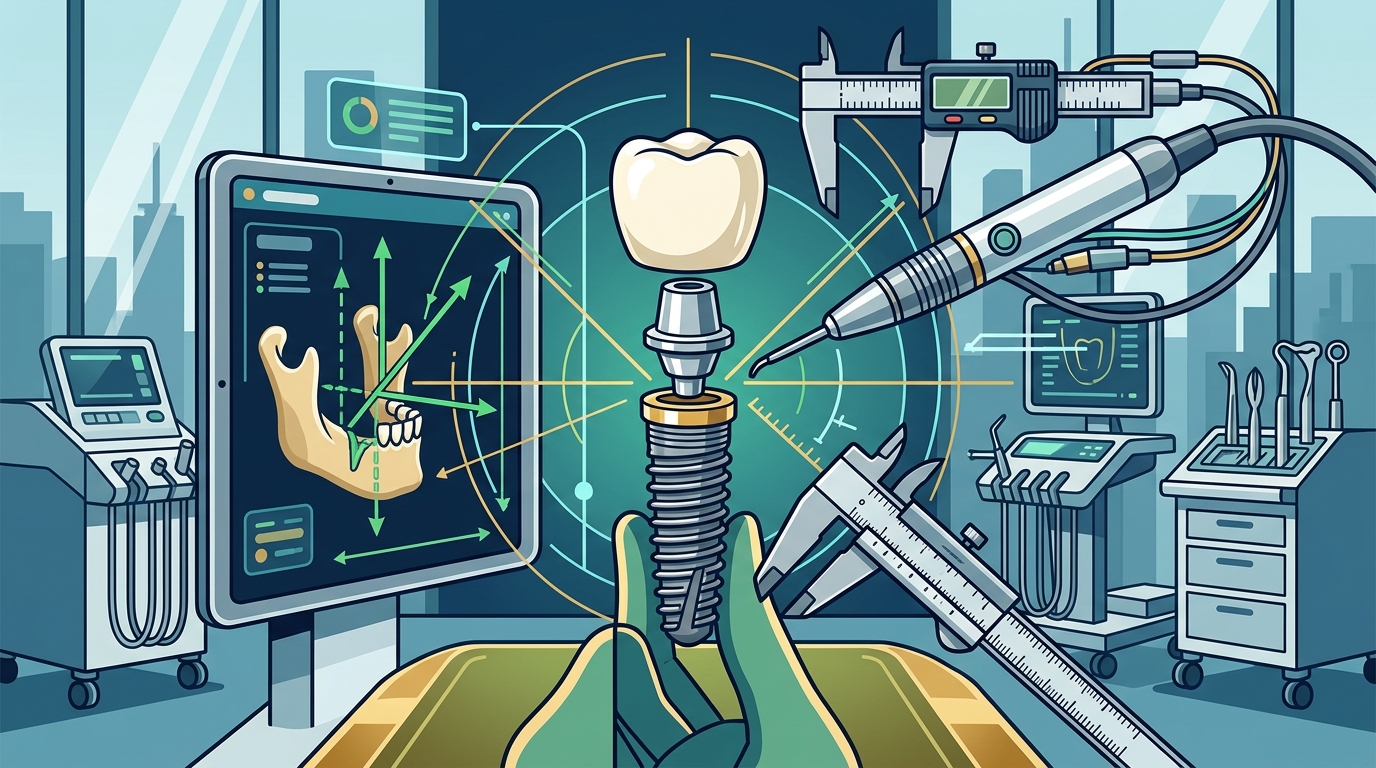
The workflow for advanced implant placement follows a strict sequence to ensure accuracy. The process begins with data acquisition, typically a Cone Beam Computed Tomography (CBCT) scan. This scan provides a 3D view of the bone, nerves, and sinuses. Next, the surgeon and a surgical technician use software to plan the surgery. They adjust the virtual implant position until it is optimal for strength and aesthetics. From this plan, a surgical guide is created, often via 3D printing. During the procedure, this guide is placed in the mouth, and the surgeon drills through it. This ensures the implant is placed exactly where planned. The use of piezoelectric saws or ultrasonic aspirators during this phase allows for precise bone cutting with minimal heat and soft tissue damage.
What It Costs: Factors Driving Price
The cost of advanced implant technology in New York City is influenced by the complexity of the case and the specific tools used. While the technology itself adds a premium, it often reduces overall costs by shortening surgery time and minimizing the need for secondary corrective procedures. Factors that drive the price up include the need for bone grafting, sinus lifts, or the use of zygomatic implants for severe bone loss. Conversely, precise planning can avoid unnecessary grafting by angling implants into existing bone. At Park Avenue Oral, Maxillofacial & Implant Surgery, the financial team works with major PPO insurance plans to maximize benefits. Understanding that precision is an investment in long-term stability helps patients weigh the initial cost against the risk of failure with less precise methods.
What Goes Wrong: Common Mistakes and Avoidance
Without advanced technology, several common errors can occur during implant placement. The most critical is nerve injury, which can cause permanent numbness in the lip or chin. This happens when a drill penetrates too deep or at the wrong angle. Another common issue is sinus perforation in the upper jaw, which can lead to chronic infections. Advanced planning and CT-guided placement mitigate these risks by mapping the exact boundaries of the nerve canal and sinus floor. Furthermore, using traditional rotary drills can generate excessive heat, which kills bone cells and leads to implant failure. Ultrasonic instruments, such as the Medtronic Piezoelectric Saw, cut bone selectively while sparing soft tissue, thereby avoiding these thermal and mechanical complications.
Versus Alternatives: Digital vs. Conventional Methods
| Feature | Conventional Placement | CT-Guided / VSP Placement |
|---|---|---|
| Planning Phase | Visual estimation and 2D X-rays | 3D CT scan and virtual simulation |
| Accuracy | Variable, dependent on surgeon experience | High, guided by physical or digital template |
| Surgical Time | Often longer due to intra-operative adjustments | Shorter, as the path is pre-determined |
| Soft Tissue Trauma | Higher risk with rotary drills | Lower risk with piezoelectric/ultrasonic tools |
| Patient Visualization | Difficult to show pre-op outcome | Can show 3D simulation of final result |
For Specific Situations: Complex Bone Loss Cases
Advanced technology is most critical in cases of severe bone loss, where conventional implants are not feasible. For patients with significant resorption of the upper jaw, zygomatic and pterygoid implants are used. These implants anchor into the dense cheekbone or the back of the skull, bypassing the need for extensive bone grafting. The placement of these long, angled implants requires extreme precision to avoid damaging the sinus or orbital structures. CT-guided planning is essential here to map the trajectory. At Park Avenue Oral, Maxillofacial & Implant Surgery, these complex cases are managed using advanced imaging and specialized surgical instruments to ensure immediate stability and function.
Rules and Protections: Safety Standards and Licensing
Oral surgeons in New York City must adhere to strict state regulations regarding anesthesia and surgical practice. The use of advanced technology does not bypass these safety standards. Surgeons must be licensed by the State of New York and inspected by governing bodies. Anesthesia administration, whether local, nitrous oxide, or IV sedation, requires specific certification and adherence to safety protocols. Patients have the right to informed consent, which includes understanding the risks and benefits of the specific technology used. Practices like Park Avenue Oral, Maxillofacial & Implant Surgery maintain privileges at major hospitals, ensuring that emergency support is available if needed, which adds an additional layer of patient protection.
Local Specifics: The NYC Oral Surgery Landscape
New York City offers a high concentration of oral surgeons, but the level of technological integration varies. Many general dentists offer implants, but they may not have the training or equipment for complex maxillofacial cases. Specialized oral and maxillofacial surgeons, particularly those with dual degrees (MD and DMD) and fellowship training, are better equipped to handle the anatomical complexities found in diverse patient populations. The NYC market also features a range of insurance networks. Choosing a surgeon who is in-network with major PPO plans can significantly reduce out-of-pocket costs. Patients should verify that the surgeon's office is equipped with the specific advanced technologies discussed, such as 3D printing for surgical guides and ultrasonic bone cutting tools.
Timing: When to Act and How Urgency Matters
Timing is a critical factor in implant success. Bone loss accelerates after a tooth is extracted. The longer a tooth is missing, the more the jawbone shrinks, potentially making future implant placement more difficult or requiring more extensive grafting. Advanced technology can mitigate some of this loss by allowing for angled placement, but it cannot reverse severe resorption. Therefore, acting promptly after tooth loss is advisable. Additionally, if you are experiencing pain or infection, delaying treatment can lead to the spread of infection. For those considering full-arch solutions like All-on-X, the planning phase takes time, but the surgical phase can often be completed in a single day, allowing for immediate function.
Results Over Time: Long-Term Outcomes
The long-term success of dental implants is closely tied to the precision of their initial placement. Implants placed with high accuracy have better load distribution, which reduces the risk of mechanical failure over time. Studies have shown that implants placed with guided surgery have higher survival rates compared to those placed conventionally, particularly in the posterior region where bone is often thin. Regular maintenance is still required, but the foundation laid by advanced technology provides a more stable platform for the crown or bridge. Patients can expect their implants to function like natural teeth for decades, provided they maintain good oral hygiene and attend regular check-ups.
Key Takeaways
- Virtual Surgical Planning (VSP) allows for 3D simulation of the surgery before it occurs, improving predictability.
- CT-guided implant placement uses a physical or digital guide to ensure the implant is placed exactly where planned.
- Piezoelectric and ultrasonic instruments cut bone with minimal heat and soft tissue damage, reducing post-op pain.
- Advanced technology is essential for complex cases like zygomatic implants, where conventional methods are not feasible.
- Choosing a surgeon with fellowship training and board certification ensures a higher level of expertise in using these tools.
- Insurance coverage for advanced technology varies, so verifying benefits with the practice's financial team is crucial.
- Prompt action after tooth loss helps preserve bone volume, making advanced implant placement easier and more successful.
- Long-term implant success is higher when placement is guided by precise 3D imaging and planning.
Frequently Asked Questions
What is Virtual Surgical Planning (VSP)?
Virtual Surgical Planning is an advanced operation design tool that uses 3D CT scans to create a virtual model of the jaw. It allows the surgeon to simulate the surgery on a computer, adjusting the jaw position and implant placement before the actual procedure.
How does CT-guided implant placement work?
The process begins with a 3D CT scan of the jaws. The surgeon plans the exact position, angle, and depth for each implant. This plan is used to create a surgical guide, which ensures the implants are placed in the ideal position during surgery.
What is a piezoelectric saw used for?
A piezoelectric saw uses ultrasonic vibrations to cut bone while leaving surrounding soft tissues, such as gums and nerves, untouched. It is used for precise cuts with less heat and reduced bleeding.
Is advanced technology more expensive?
While the technology itself adds a cost, it can often reduce overall expenses by shortening surgery time and minimizing the need for secondary corrective procedures. The exact cost depends on the complexity of the case.
Who is a candidate for zygomatic implants?
Zygomatic implants are designed for patients with severe upper jaw bone loss where conventional implants are not feasible. They anchor into the dense cheekbone, providing strong support for dental restorations.
How long does the planning phase take?
The planning phase involves data acquisition and virtual simulation. This can take a few weeks, depending on the complexity of the case and the need for patient consultation to ensure the design is aesthetically appealing.