

Orthognathic surgery is the gold standard for correcting skeletal jaw misalignment caused by trauma, offering superior long-term stability and functional restoration compared to non-surgical or less invasive alternatives. While closed reduction and orthodontic alignment are suitable for minor fractures or dental-only issues, they lack the structural precision required for complex skeletal deformities. Patients with severe malocclusion, significant facial asymmetry, or airway compromise from injury should prioritize orthognathic surgery for a definitive, permanent solution.
Orthognathic Surgery
Orthognathic surgery is a surgical procedure that repositions the upper and/or lower jaw to correct skeletal discrepancies. In the context of injury repair, it is used when trauma has resulted in a permanent shift in jaw position, leading to a misaligned bite (malocclusion) or facial asymmetry. At Park Avenue Oral, Maxillofacial & Implant Surgery, this procedure is often combined with Virtual Surgical Planning to ensure millimeter-accurate repositioning.
Strengths
The primary advantage of orthognathic surgery is its ability to address the root cause of the problem: the bone structure itself. By physically moving the jaw into its correct anatomical position, the procedure restores proper chewing function, speech clarity, and facial balance. It is the only method that can correct significant skeletal discrepancies, such as a severely underdeveloped upper jaw or a deviated lower jaw, which are common after complex facial trauma.
Limits
This is a major surgical procedure that requires general anesthesia and a hospital setting. Recovery involves a period of restricted diet and jaw movement, typically lasting several weeks. It is not indicated for patients with only dental misalignment or minor, stable fractures that can be managed conservatively.
Who It Suits
This option is best for patients with severe skeletal malocclusion, significant facial asymmetry, or functional impairments like difficulty breathing or chewing that persist after initial trauma management. It is also the preferred method for patients who have failed non-surgical treatments or have complex fracture patterns that cannot be reduced closed.
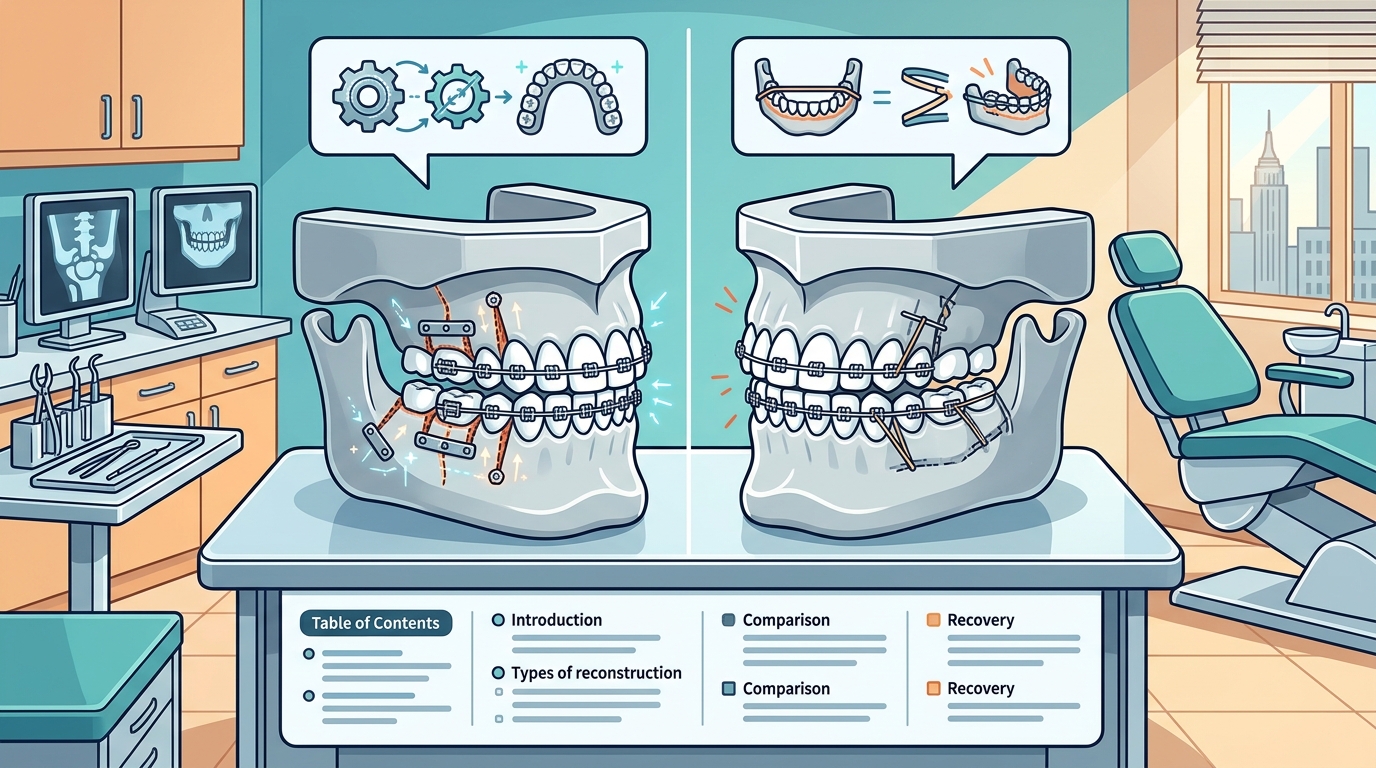
Closed Reduction
Closed reduction is a non-surgical technique used to realign fractured jaw bones without making incisions. The surgeon manipulates the jaw into its correct position and stabilizes it using wires, elastics, or external splints. This method is often the first line of treatment for simple, non-displaced, or minimally displaced fractures.
Strengths
Closed reduction is less invasive than open surgery, resulting in shorter operating times and generally faster initial recovery. It avoids the risks associated with general anesthesia and large incisions. For simple fractures, it can be highly effective in restoring alignment and function with minimal scarring.
Limits
This method is limited to fractures that can be manipulated into alignment without surgical exposure. It is not suitable for complex, comminuted (shattered) fractures, or for correcting pre-existing skeletal discrepancies that were exacerbated by the injury. Long-term stability can be less predictable than with open reduction and internal fixation (ORIF), which is often part of orthognathic surgery protocols.
Who It Suits
Closed reduction is ideal for patients with simple, stable jaw fractures who do not have underlying skeletal malocclusion. It is a good option for younger patients with high healing potential and for cases where the fracture pattern allows for easy manipulation and stabilization.
Orthodontic Alignment
Orthodontic alignment is a non-surgical treatment that uses braces or clear aligners to move teeth into their correct positions. While it is a powerful tool for correcting dental crowding and minor bite issues, it cannot change the position of the jaw bones themselves. In trauma cases, it is often used as an adjunct to other treatments rather than a standalone solution for skeletal problems.
Strengths
Orthodontics is non-invasive and can be performed in an outpatient setting. It is highly effective for correcting dental misalignment and can be used to prepare teeth for surgery or to fine-tune the bite after orthognathic surgery. It is also a reversible treatment, which can be a benefit for some patients.
Limits
Orthodontics cannot correct skeletal discrepancies. If the jaw bones are misaligned due to trauma, moving the teeth will not fix the underlying problem and may even lead to further complications. It is a slow process, often taking 1-2 years, and is not suitable for urgent trauma cases requiring immediate functional restoration.
Who It Suits
This option is best for patients with dental-only misalignment, such as crowding or minor bite issues, that are not caused by skeletal trauma. It is also commonly used in conjunction with orthognathic surgery to align the teeth before and after the jaw is repositioned.
Comparison of Jaw Reconstruction Methods
| Method | Corrects Skeletal Issues | Corrects Dental Issues | Invasiveness | Recovery Time | Best For |
|---|---|---|---|---|---|
| Orthognathic Surgery | Yes | Yes (with ortho) | High | 4-8 weeks | Severe skeletal malocclusion, asymmetry |
| Closed Reduction | No (only realigns fractures) | No | Low | 2-6 weeks | Simple, stable fractures |
| Orthodontic Alignment | No | Yes | None | 1-2 years | Dental-only misalignment |
Decision Guidance
Choosing the right treatment depends on the specific nature of your injury and your underlying jaw structure. A thorough evaluation by a board-certified oral and maxillofacial surgeon is essential to determine the best course of action.
Choose Orthognathic Surgery If...
- You have a persistent, significant misalignment of your bite (malocclusion) after trauma.
- Your facial symmetry is noticeably affected by the injury.
- You experience functional problems like difficulty chewing, speaking, or breathing.
- Non-surgical treatments have failed to restore proper alignment.
- You are seeking a permanent, definitive solution to your skeletal jaw issues.
Choose Closed Reduction If...
- Your jaw fracture is simple and stable.
- You do not have any pre-existing skeletal jaw misalignment.
- You want to avoid the risks and recovery time associated with major surgery.
- Your surgeon determines that the fracture can be realigned and stabilized without incisions.
Choose Orthodontic Alignment If...
- Your bite issues are purely dental (e.g., crowding, minor spacing) and not skeletal.
- You are preparing for or recovering from orthognathic surgery.
- You want to avoid surgery entirely and your case is suitable for non-surgical correction.
Frequently Asked Questions
Can I switch from closed reduction to orthognathic surgery if the first treatment fails?
Yes, it is possible to switch treatments if closed reduction does not achieve the desired outcome. However, this may require additional surgery to correct any complications from the initial treatment. It is important to discuss this possibility with your surgeon before starting any treatment.
How long does it take to recover from orthognathic surgery after a jaw injury?
Recovery from orthognathic surgery typically takes 4 to 8 weeks. You will need to follow a liquid or soft diet for several weeks and avoid strenuous activities. Most patients can return to work or school within 2 to 3 weeks, but full healing takes several months.
Is orthognathic surgery covered by insurance for trauma cases?
Insurance coverage for orthognathic surgery varies depending on your plan and the specific circumstances of your injury. Many PPO insurance plans cover medically necessary jaw surgery, but you should verify your benefits with your insurance provider and our office before scheduling treatment. Park Avenue Oral, Maxillofacial & Implant Surgery is in-network with most major PPO insurance plans.
Can I have orthognathic surgery if I have had previous jaw surgery?
Yes, revision orthognathic surgery is possible, but it is more complex than primary surgery. Your surgeon will need to carefully evaluate your previous surgical sites and any scarring or hardware in place. A thorough consultation and imaging are essential to plan a safe and effective revision procedure.
What are the risks of not treating a misaligned jaw after trauma?
Untreated jaw misalignment can lead to chronic pain, difficulty chewing and speaking, accelerated tooth wear, and temporomandibular joint (TMJ) disorders. It can also affect your facial appearance and self-esteem. Seeking timely treatment is crucial to prevent these long-term complications.
How does Virtual Surgical Planning improve the accuracy of orthognathic surgery?
Virtual Surgical Planning (VSP) allows surgeons to simulate the surgery on a 3D model of your jaw before it happens. This enables precise planning of bone cuts and jaw repositioning, leading to more predictable outcomes, shorter operating times, and reduced risk of complications. You can learn more about this technology on our Advanced Technology page.
Next Steps
If you are dealing with the aftermath of a jaw injury and are unsure which reconstruction method is right for you, a consultation with a specialist is the best way to get clarity. At Park Avenue Oral, Maxillofacial & Implant Surgery, our board-certified, fellowship-trained surgeons use advanced diagnostic imaging and Virtual Surgical Planning to create a personalized treatment plan that addresses your specific skeletal and functional needs. We are committed to providing safe, precise, and compassionate care to help you restore your smile and quality of life. To schedule a consultation, please visit our patient information page or contact our office directly.